
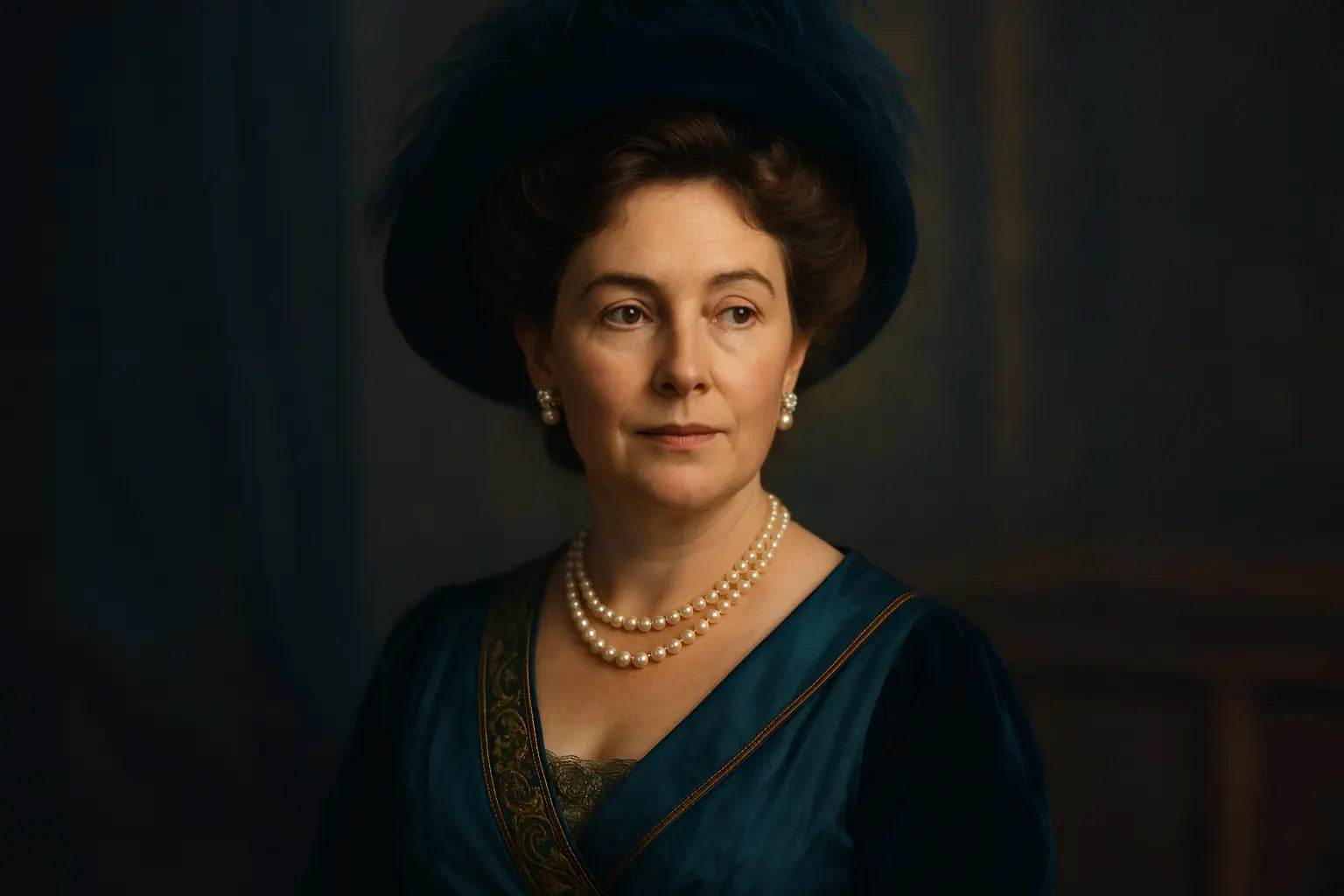

🕯️ Introduction – Who Was Charlotte Drake Cardeza?
Among the many names linked to the legend of the RMS Titanic, Charlotte Drake Cardeza stands out as one of the ship’s wealthiest and most extensively documented survivors. Born Charlotte Wardle Drake, she travelled in first class with her son Thomas Drake Martinez Cardeza, her maid, and her son’s valet. Their party occupied one of the most luxurious and expensive suites aboard the ship.
Charlotte is sometimes described online as the “Titanic’s richest survivor”, but surviving records do not provide a reliable ranking of the personal fortunes of every survivor. What can be established is more precise: she occupied the ship’s most expensive stateroom, travelled with an extraordinary quantity of luggage, and later filed the largest and most detailed property-loss claim connected with the disaster.

Her 14 trunks, 4 suitcases, and 3 crates contained clothing, jewellery, furs, cash, and other personal possessions. The scale of the inventory offers a remarkable glimpse into first-class transatlantic travel during the Gilded Age.
Modern searches such as titanic charlotte cardeza, charlotte cardeza net worth, and what was charlotte cardeza job reflect the continuing interest in her story. Yet the most compelling facts are not legends: they are preserved in passenger records, contemporary newspaper accounts, and Charlotte’s extensive claim for property lost when the Titanic sank.
➡️ Many still ask, Was the Heart of the Ocean a real thing? Explore the legend, the inspiration, and the timeless beauty behind this unforgettable Titanic jewel.
💎 The Fortune and Lifestyle of Charlotte Cardeza
Charlotte Wardle Drake was born into a prosperous Philadelphia family. Her father, Thomas Drake, was described in contemporary sources as an industrialist and banker, and his fortune was closely associated with textile manufacturing and property. Charlotte inherited substantial wealth and lived at Montebello, the family’s large home in Germantown, Pennsylvania.
Although her exact personal net worth cannot be established from surviving records, her lifestyle clearly placed her among the affluent elite of her time. She was a noted yachtswoman, traveller, big-game hunter, patron of the arts, and supporter of private charities.
The most concrete evidence of her wealth is the baggage she brought aboard the Titanic: 14 trunks, 4 suitcases, and 3 crates. After the sinking, she filed a claim listing at least 841 individual items and valuing her losses at $177,352.75 in 1912. The inventory included clothing, furs, jewellery, cash, and a pink diamond ring valued at $20,000.

Charlotte and Thomas occupied cabins B-51, B-53, and B-55, part of one of the Titanic’s two most luxurious parlour suites. The accommodation included bedrooms, a sitting room, a bathroom, and a private promenade deck. Their ticket, number 17755, carried a recorded fare of £512 6s 7d, commonly estimated at about $2,560 in 1912.
Charlotte’s historical importance therefore rests not on an unverifiable claim that she was definitively the richest survivor, but on well-documented distinctions: the most expensive stateroom, an exceptionally large amount of luggage, and the largest property-loss claim filed after the disaster.
➡️ Continue your exploration of the Titanic legend with our article on Jack Dawson, the unforgettable artist whose story moves millions.
💼 What Was Charlotte Cardeza’s Profession?
A frequent query is “what was Charlotte Cardeza’s job?” In the modern sense, she did not hold a conventional salaried profession. She was a wealthy woman of independent means whose life centred on travel, family property, charitable activity, and cultural interests.
Contemporary accounts describe her more specifically as:
- A yachtswoman who travelled widely and at times took an active role aboard her yacht, the Eleanor.
- A big-game hunter who joined expeditions in Africa and Asia.
- A patron of the arts who visited galleries during her travels.
- A supporter of private charities in and around Philadelphia.
It is therefore more accurate to describe Charlotte as an heiress, traveller, yachtswoman, and philanthropically active social figure than to assign her a modern occupation that is not supported by the records.

🚢 Why Did Charlotte Cardeza Board the Titanic?
Charlotte Drake Cardeza and her son Thomas were returning to the United States after travelling abroad. They joined the RMS Titanic at Cherbourg, France, on April 10, 1912, rather than at Southampton.
The party consisted of Charlotte, Thomas, Charlotte’s maid Annie Moore Ward, and Thomas’s valet Louis Gustave Joseph Lesueur. All four travelled under ticket number 17755 and occupied the B-deck parlour suite formed by cabins B-51, B-53, and B-55.

The Titanic offered the privacy and comfort expected by wealthy transatlantic travellers. The Cardezas’ suite had its own private promenade and ranked among the finest accommodation available on the ship. Their baggage claim later showed that the party travelled with an extensive wardrobe, jewellery, furs, and other costly possessions.
Charlotte did not board the ship for a special public occasion or professional mission. The voyage was a return crossing to America after travel abroad, made aboard the newest luxury liner serving the North Atlantic route.
➡️ Inspired by the legendary Titanic jewel, the Heart of the Ocean Bracelet captures the same feeling of eternal love and destiny beneath the waves.
❄️ The Sinking – How Charlotte Survived the Titanic
Late on April 14, 1912, the Titanic struck an iceberg in the North Atlantic. According to Thomas Cardeza’s contemporary account, he had gone to bed but was still awake when he felt the collision. He awakened his mother and the two servants, and the group dressed quickly before making their way to the boat deck.
They first encountered crowds near the lifeboats, then returned to the forward part of the starboard side, where a boat was being loaded. Charlotte and her maid entered first. The officer called for additional women, but none were immediately available. He then called for male passengers, allowing Thomas and several other men to board.

Charlotte, Thomas, Annie Ward, and Gustave Lesueur all escaped in lifeboat 3, an early starboard-side boat. Thomas estimated that it carried approximately 43 to 45 people and was not completely full when it was lowered.
The survivors were later taken aboard the RMS Carpathia, which brought them to New York on April 18, 1912. All four members of the Cardeza party survived.
A later obituary stated that Charlotte had refused to leave the Titanic until a place was made for her son. Thomas’s own 1912 account provides the more detailed version: he boarded after the officer had called repeatedly for women and then invited nearby male passengers to enter the boat.

👦 Her Son - Thomas Drake Martinez Cardeza
Thomas Drake Martinez Cardeza was born on May 10, 1875. He was therefore 36 years old, not 35, when he travelled aboard the Titanic with his mother.
Thomas was a wealthy banker from Germantown who later became known as an explorer and art collector. He also served on the board of the Fidelity Trust Company and its successor, the Fidelity-Philadelphia Trust Company. During the First World War, he worked in Vienna as an assistant commissioner.

His account of the sinking, published by the New York Sun on April 27, 1912, is one of the clearest surviving descriptions of how the Cardeza party reached lifeboat 3. He explained that his mother and her maid entered first and that male passengers were invited aboard only after the officer could find no additional women nearby.
Thomas survived alongside Charlotte and the two servants. He died on June 6, 1952, at the age of 77 and was buried beside his mother at West Laurel Hill Cemetery in Pennsylvania.
➡️ Was Rose from Titanic a real person? Explore the love, loss, and legend behind her story and the iconic Heart of the Ocean.
📜 Life After the Titanic - What Happened to Charlotte Cardeza?
After arriving in New York aboard the Carpathia, Charlotte returned to her life in Germantown, Pennsylvania. Contrary to later claims that she never spoke publicly about the disaster, a short statement attributed to her appeared in the Washington Times on April 19, 1912. She said that she could not bear to recall the event and expressed gratitude that her party had survived.
Charlotte continued to travel and remained associated with charitable activity and the arts. Her obituary remembered her as a yachtswoman, big-game hunter, patron of the arts, and generous supporter of private charities.

In her final years, illness confined her to her home, Montebello, in Germantown. She died there on August 1, 1939, at the age of 85. Records identify heart disease or heart failure as the cause of death.
Charlotte was buried at West Laurel Hill Cemetery in Bala Cynwyd, Pennsylvania. Her legacy is preserved not only through the Titanic passenger lists but also through her extraordinary property claim, contemporary press coverage, and the later historical record of her family.
➡️ Embrace timeless elegance with the Titanic Ring, a dazzling blue heart that captures the spirit of eternal love and destiny.
🎬 Charlotte Cardeza in Films and Popular Culture
Charlotte Drake Cardeza is not a named character in James Cameron’s Titanic (1997), and there is no reliable evidence that she directly inspired Rose DeWitt Bukater or another principal character in the film.
It is also unsafe to claim that unnamed women in A Night to Remember (1958) were specifically based on Charlotte. Wealthy first-class passengers appear in many Titanic dramatizations, but visual resemblance or a similar social background does not prove a direct connection.

Charlotte’s place in popular Titanic history comes instead from documented facts: her luxurious B-deck suite, the scale of her luggage, her survival in lifeboat 3, and the detailed property claim now preserved by the U.S. National Archives.
Her story remains especially useful for understanding the contrast between the extreme luxury of first-class travel and the vulnerability shared by everyone aboard the Titanic on the night of the sinking.
➡️ For those inspired by the elegance of the era, our Titanic jewelry collection blends cinematic beauty with the enduring fascination surrounding the ship.
📖 Key Facts About Charlotte Drake Cardeza
- Birth name: Charlotte Wardle Drake
- Married name: Charlotte Drake Martinez Cardeza
- Birth: April 10, 1854, Pennsylvania, USA
- Death: August 1, 1939, Germantown, Pennsylvania, USA, aged 85
- Nationality: American
- Family: Mother of Thomas Drake Martinez Cardeza (1875–1952)
- Known for: Heiress, yachtswoman, traveller, big-game hunter, patron of the arts, and Titanic survivor
- Embarkation: Cherbourg, France, on April 10, 1912
- Class aboard the Titanic: First class
- Cabins: B-51, B-53, and B-55, with a private promenade
- Ticket: Number 17755, fare £512 6s 7d
- Companions: Her son Thomas, her maid Annie Moore Ward, and Thomas’s valet Louis Gustave Joseph Lesueur
- Luggage: 14 trunks, 4 suitcases, and 3 crates
- Lifeboat: Number 3
- Property claim: $177,352.75 for at least 841 listed items
- Was she the Titanic’s richest survivor? No authoritative surviving record establishes that ranking. She is securely documented as the occupant of the ship’s most expensive stateroom and the filer of its largest property-loss claim.

🎤 Statements and Historical Records
Charlotte Cardeza did not appear in the witness index for the official U.S. Senate inquiry, and there is no reliable evidence that she testified before the British Board of Trade inquiry. The quotations previously attributed to her about the officers being “brave men” or the night being filled with “fear and silence” are not supported by the official inquiry records.
The strongest surviving records connected with Charlotte are instead:
- A short contemporary newspaper statement published by the Washington Times on April 19, 1912.
- Thomas Cardeza’s detailed account of the evacuation, published by the New York Sun on April 27, 1912.
- Charlotte’s 1913 property claim, preserved in the Records of the U.S. District Courts and available through the U.S. National Archives.
Her property claim is historically important because it lists the contents of 14 trunks, 4 suitcases, and 3 crates in nearly 20 pages. It is the largest and most detailed Schedule B claim for property lost on the Titanic.
These records provide a firmer basis for understanding Charlotte’s experience than later dramatic retellings. They confirm her accommodation, companions, lifeboat, losses, and survival without relying on invented dialogue.
➡️ The Heart of the Ocean Earrings capture the spirit of the Titanic: passion, grace, and a touch of eternal romance.
❓ FAQ About Charlotte Drake Cardeza
🛟 Did Charlotte Drake Cardeza survive the Titanic?
Yes. Charlotte survived in lifeboat 3 with her son Thomas, her maid Annie Ward, and Thomas’s valet Gustave Lesueur. They were rescued by the Carpathia.
🚢 Where did Charlotte Cardeza board the Titanic?
She boarded at Cherbourg, France, on April 10, 1912. She did not embark at Southampton.
🚢 Why did Charlotte Cardeza board the Titanic?
She and her son were returning to the United States after travelling abroad. They chose first-class accommodation aboard the new White Star Line vessel for their transatlantic crossing.

💼 What was Charlotte Cardeza’s profession?
She had no conventional salaried occupation. She is best described as an heiress, yachtswoman, traveller, big-game hunter, patron of the arts, and supporter of private charities.
👦 Who was Charlotte Cardeza’s son?
Thomas Drake Martinez Cardeza (1875–1952) was a banker, explorer, and art collector. He was 36 when he survived the Titanic with his mother.
💎 Was Charlotte Cardeza the Titanic’s richest survivor?
That claim cannot be verified from authoritative surviving records. What is certain is that she occupied the ship’s most expensive stateroom and filed the largest and most detailed claim for lost property.
💎 How much property did Charlotte Cardeza lose?
Her claim valued the contents of 14 trunks, 4 suitcases, and 3 crates at $177,352.75 in 1912. The inventory contained at least 841 separate items.
📜 What happened to Charlotte after the Titanic?
She returned to Germantown, continued travelling and supporting charitable and artistic interests, and died at her home on August 1, 1939, aged 85.

🏛️ Where can I find records about Charlotte Cardeza?
The most useful records include Titanic passenger lists, her property-loss claim in the U.S. National Archives, contemporary newspaper accounts, and specialist passenger biographies. She was not an official witness before the U.S. Senate inquiry.
📌 Conclusion – Wealth, Survival, and Historical Legacy
Charlotte Drake Cardeza remains one of the most striking examples of first-class luxury aboard the Titanic. Her private promenade suite, enormous quantity of luggage, and record-setting property claim reveal the extraordinary wealth carried aboard the ship.
Her story is also a reminder of the importance of distinguishing documented history from later embellishment. Charlotte was born in 1854, boarded at Cherbourg, occupied cabins B-51, B-53, and B-55, survived in lifeboat 3, and died in Pennsylvania in 1939 at the age of 85.
Those verified facts are more compelling than invented quotations or unsupported claims about films, official testimony, or a definitive ranking as the Titanic’s richest survivor. They preserve Charlotte Cardeza’s genuine place in the history of the disaster.

*The visuals featured in this article are original illustrations created by our editorial team with the assistance of artificial intelligence tools. They do not depict the actual people mentioned and do not reproduce any copyrighted material.




Gabriella
June 23, 2026
This really helped with my school homework, and the essay im writing. Thanks! > – <