
Last updated: August 3, 2026 · By the Heart of the Ocean editorial team
Table of Contents
🕯️ Introduction
Frederick Fleet was the Titanic lookout who first spotted the iceberg directly ahead of the ship. At approximately 11:40 p.m. on April 14, 1912, he saw a dark shape emerging from the moonless horizon, rang the crow’s nest bell three times and telephoned the bridge with the warning that has become inseparable from the disaster: “Iceberg, right ahead!”

The warning was passed on immediately, but the Titanic was already dangerously close to the ice. First Officer William Murdoch ordered an emergency turn, yet the ship could not clear the obstacle completely. The collision damaged several areas along the starboard side and allowed seawater to enter the forward compartments.
Fleet’s name has therefore become attached to one of the most dramatic moments in maritime history. Yet he was neither the man commanding the Titanic nor the person responsible for its speed. He was a 24-year-old professional seaman carrying out a demanding watch in unusually difficult conditions: a calm sea, a dark horizon and no binoculars in the crow’s nest.
Who was Frederick Fleet before the Titanic? Why were the lookouts not given binoculars? Could the iceberg have been seen sooner? Did Frederick Fleet survive the sinking, and who played him in James Cameron’s 1997 movie? His story reaches far beyond the few seconds shown on screen.
👤 Who Was Frederick Fleet?
Frederick Fleet was born in Liverpool, England, on October 15, 1887. His early life was unsettled. After being abandoned by his mother at a young age, he was raised by foster families, relatives and charitable institutions before being sent to a training ship at around the age of 12.
That experience introduced him to life at sea. Fleet began working as a deck boy in 1903 and gradually advanced through the ranks until he became an able seaman. By the time he joined the Titanic, he was not an inexperienced recruit but a professional sailor with several years of service behind him.
Before the Titanic’s maiden voyage, Fleet spent roughly four years aboard the Oceanic, another White Star Line passenger ship. He had already worked as a lookout there, learning how to scan the horizon, identify hazards and report anything that might threaten the ship’s course.

Lookout duty demanded patience and concentration. A man stationed in the crow’s nest had to remain alert in cold, exposed conditions while distinguishing ships, fog banks, wreckage and ice from the changing surface of the sea. Good eyesight mattered, but so did experience: a distant object might first appear only as a shadow, a break in the horizon or an unusual patch of darkness.
Fleet signed on to the Titanic in Southampton in April 1912. He was one of six lookouts assigned to the ship, working in pairs and rotating through the crow’s nest high on the forward mast. His wages were modest, but his responsibility was considerable. The lookouts formed the ship’s first visual warning system.
At 24, Frederick Fleet was younger than many of the officers whose decisions shaped the voyage, but he was already familiar with the routines of a major transatlantic liner. His place in history would ultimately be decided not by a long career or senior rank, but by a few seconds of observation on the final night of the Titanic.
🔭 Frederick Fleet, Lookout on the Titanic
On the evening of April 14, 1912, Frederick Fleet shared lookout duty with Reginald Robinson Lee. The two men entered the crow’s nest at 10:00 p.m., taking over from Archie Jewell and George Symons.
Before leaving the post, the previous lookouts passed on an important warning: keep a particularly close watch for small pieces of ice and low-lying growlers, which could be difficult to distinguish against the dark surface of the Atlantic.
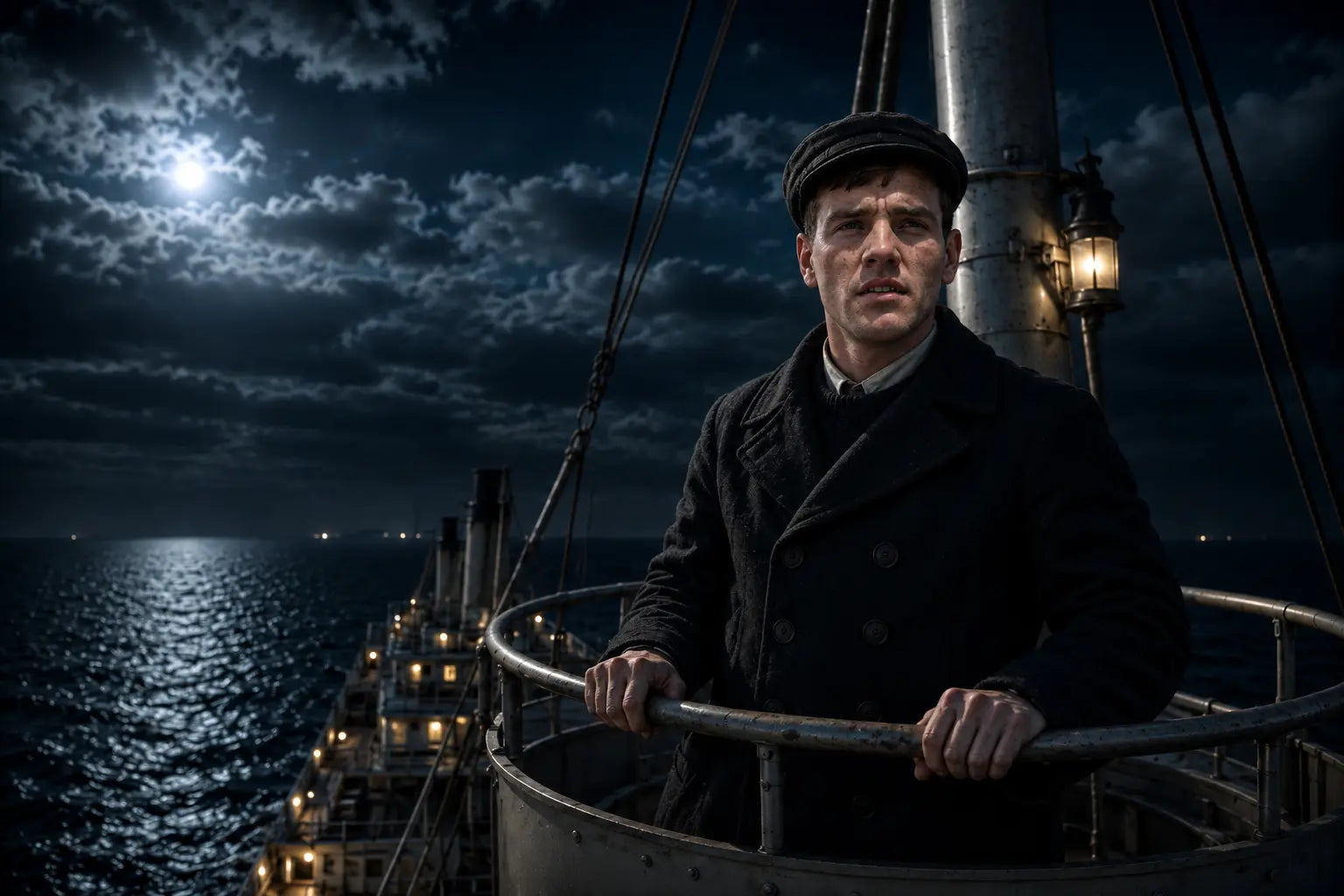
The conditions that night made their task unusually demanding. The sky was clear, but there was no moon. The sea was exceptionally calm, and without waves breaking against the ice, there was little white foam to reveal an iceberg’s position.

From the crow’s nest, Fleet and Lee had an unobstructed view ahead, but the horizon was almost entirely black. They had to rely on subtle changes in shape and contrast rather than on a brightly visible object.
Their role was limited but crucial. The lookouts could not slow the Titanic or alter its course. If they saw a hazard, they were expected to ring the warning bell and telephone the bridge immediately. The decision about how to respond belonged to the officers on duty.
That distinction matters when considering Frederick Fleet’s place in the disaster. He was not responsible for navigation, speed or engine orders. His job was to see danger and report it as quickly as possible.
🧊 The Night Frederick Fleet Spotted the Iceberg
At about 11:40 p.m. on April 14, 1912, Frederick Fleet noticed something ahead of the Titanic. It did not appear as a brilliant white wall of ice. Against the moonless sky and the unusually calm sea, it first looked like a dark mass interrupting the horizon.
The shape grew rapidly as the ship continued forward. Fleet immediately understood that an object lay directly in the Titanic’s path. He struck the crow’s nest bell three times, the signal used to tell the bridge that something was straight ahead.
He then turned to the telephone connecting the lookout post to the bridge. When an officer, most likely Sixth Officer James Moody, asked what he could see, Fleet delivered the warning that would become famous: “Iceberg, right ahead!”

The message was passed at once to First Officer William Murdoch, who ordered an emergency maneuver and acted on the engine controls. The Titanic began to turn, but the distance remaining was too short for the ship to clear the iceberg completely.
From the crow’s nest, Fleet and Reginald Lee watched the ice pass along the starboard side. Fleet could never give investigators a precise estimate of how far away it had been when he first saw it. What remained consistent in his testimony was that he rang the bell and telephoned the bridge as soon as he identified the danger.
His warning was therefore not delayed. The problem was that by the time the iceberg became visible from the lookout position, the Titanic was already traveling too close to it for a successful avoidance maneuver to be guaranteed.
➡️ The moment Fleet saw the iceberg remains one of the most unforgettable scenes in Titanic history. The Heart of the Ocean necklace carries that same sense of deep-blue brilliance and cinematic memory.
🔍 Why Did the Titanic Lookouts Have No Binoculars?
The missing binoculars have become one of the most debated details of the Titanic disaster. During the maiden voyage, Frederick Fleet and Reginald Lee had to scan the horizon with the naked eye. No binoculars were available in the crow’s nest on the night of April 14, 1912.
A pair had apparently been used while the Titanic traveled from Belfast to Southampton, but it was not returned to the lookout post before the ship sailed for New York. Their absence may have been linked to the last-minute reshuffling of the ship’s officers, when David Blair left the crew after Henry Wilde joined it, although the surviving evidence does not allow every step to be reconstructed with certainty.
A widely repeated story claims that Blair accidentally took the key to a locked cabinet containing the binoculars. The reality is less clear-cut. The testimony shows that the lookouts knew binoculars had been aboard earlier, but none were supplied to them for the crossing.

Fleet later told investigators that he had used binoculars while serving as a lookout on the Oceanic. He believed they might have helped him see the iceberg sooner. That statement, however, needs context. Lookouts normally searched the horizon with the naked eye because binoculars narrow the field of view. They were generally more useful for identifying an object that had already been noticed.
Charles Lightoller also explained that a lookout who suspected danger was expected to raise the alarm first, rather than spend valuable time examining the object through binoculars. In that sense, the glasses might have helped Fleet confirm what he was seeing, but they would not necessarily have transformed the outcome.
It is therefore impossible to say that binoculars would have saved the Titanic. They may have offered an additional advantage, yet they could not remove the other dangers present that night: a moonless sky, an unusually calm sea, the ship’s speed and the short distance remaining when the iceberg finally became visible.
🛟 Did Frederick Fleet Survive the Titanic?
Yes. Frederick Fleet survived the sinking of the Titanic. After the collision, he remained in the crow’s nest for a short time with Reginald Lee before leaving the lookout post and making his way to the boat deck.
There, Second Officer Charles Lightoller ordered Fleet to help prepare and lower Lifeboat No. 6. Because the boat needed experienced crewmen who could row, Fleet was then told to take a place inside it.

He did not leave the Titanic as a passenger seeking safety for himself. He entered the lifeboat as a working member of the crew, expected to help pull away from the sinking liner and assist with the boat’s handling.
Quartermaster Robert Hichens was placed in charge. Fleet took an oar alongside the other occupants. Among the women aboard were Margaret Brown, Helen Candee and Elizabeth Rothschild.
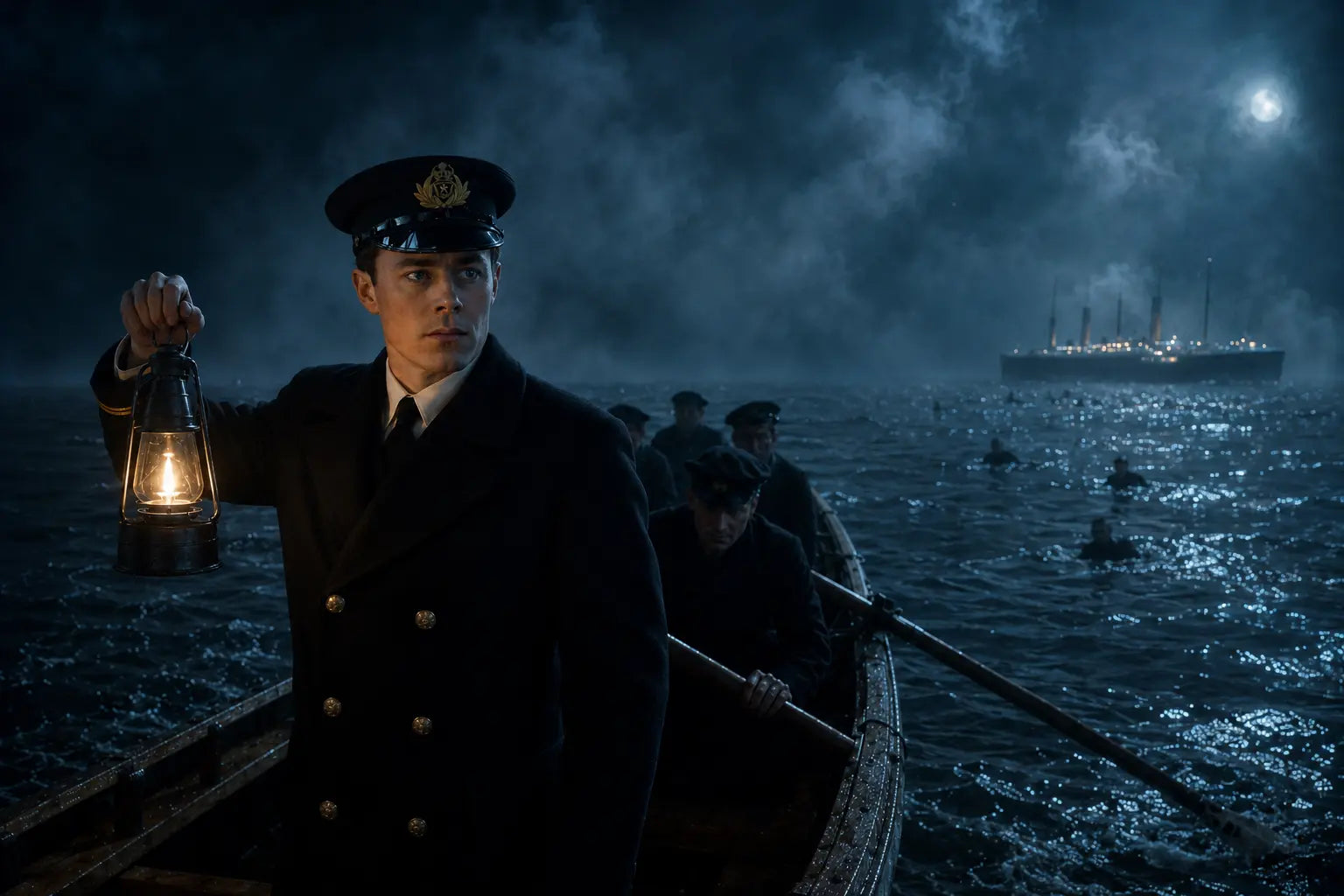
Lifeboat No. 6 left the Titanic with far fewer people than it could carry. From the boat, Fleet watched the ship disappear beneath the Atlantic less than two hours after he had first warned the bridge about the iceberg.
The survivors could hear cries coming from the water after the ship went down. Some passengers wanted the boat to return, but Hichens resisted, fearing that people in the sea might overwhelm it. Fleet later testified that he did not challenge the decision and continued rowing.
After several hours exposed to the cold, Fleet and the other occupants were rescued by the Carpathia. His survival gave investigators a rare first-hand account of the moment the iceberg was sighted, the warning sent to the bridge and the events aboard Lifeboat No. 6.

⚖️ His Testimony and Responsibility for the Disaster
After reaching New York aboard the Carpathia, Frederick Fleet was called to testify before the United States Senate inquiry into the Titanic disaster. He later appeared before the British inquiry, where he was questioned again about the sighting of the iceberg, the missing binoculars and the conditions in the crow’s nest.
Investigators asked Fleet to describe exactly what he had seen. He explained that the iceberg first appeared as a dark object ahead of the ship, that he rang the bell three times and that he telephoned the bridge immediately. His account remained consistent on these essential points.
He was also pressed to estimate the distance between the Titanic and the iceberg at the moment of discovery. Fleet refused to provide a figure he could not support. From the crow’s nest, in darkness and without a reliable visual reference, he could not judge the distance accurately.
The binoculars became one of the most discussed parts of his testimony. Fleet stated that he believed he would have seen the iceberg sooner if a pair had been available. The British inquiry did not accept that their absence alone explained the disaster, but his answer helped turn the missing glasses into one of the most enduring questions surrounding the Titanic.

Frederick Fleet was never found responsible for the sinking. He had no authority over the ship’s speed, course or engine movements. His duty was to watch the sea ahead and report danger, and the evidence showed that he raised the alarm as soon as he recognized the iceberg.
The inquiries focused more broadly on the Titanic’s speed, the ice warnings received during the voyage and the organization of the ship’s lookout arrangements. Fleet was one part of a much larger chain of decisions made before the iceberg appeared.
Popular retellings sometimes reduce the disaster to the idea that the lookout should simply have seen the iceberg earlier. That interpretation overlooks the conditions of the night and the limits of Fleet’s role. He was the man who saw the danger and sounded the warning, not the man who chose how fast the Titanic would travel through an area where ice had been reported.
➡️ Fleet’s testimony helped preserve the details of that final watch for future generations. The Heart of the Ocean earrings offer a refined way to wear a symbol of Titanic’s enduring memory.
🌑 What Happened to Frederick Fleet After the Titanic?
After the disaster, Frederick Fleet briefly returned to sea with the White Star Line and served aboard the Olympic, the Titanic’s sister ship. He did not remain with the company for long, however, and left later in 1912.
Like several surviving crew members, Fleet found that the Titanic followed him into civilian life. The disaster made his name recognizable, but it did not bring financial security or lasting public status.
He continued working at sea for other employers and served in the merchant marine during the First World War. Fleet remained in maritime employment for much of the interwar period before eventually moving into shore-based work in Southampton.
In later life, he held a number of modest jobs and was known to sell newspapers in the city. Many of the people who passed him in the street may never have realized that he was the lookout who had first spotted the Titanic iceberg.

His final years were difficult. After the death of his wife, Eva, on December 28, 1964, Fleet was left deeply affected and increasingly isolated. He died by suicide in Southampton on January 10, 1965, at the age of 77.
Some later accounts have presented his death as the result of guilt over the Titanic. That conclusion cannot be established with certainty. The immediate circumstances were more closely connected to bereavement, loneliness and financial insecurity.
Frederick Fleet was buried at Hollybrook Cemetery in Southampton. His grave remained unmarked for many years before a memorial stone bearing his name and an image of the Titanic was installed in 1993.
➡️ More than a century later, the Titanic continues to leave its mark across generations. With its luminous blue heart and adjustable band, the Heart of the Ocean ring offers a delicate way to keep that story close.
🎬 Frederick Fleet in Titanic (1997) and Other Adaptations
In James Cameron’s 1997 film Titanic, Frederick Fleet is played by British actor Scott G. Anderson. Reginald Lee, the second lookout on duty in the crow’s nest, is portrayed by Martin East.
The scene closely follows the basic sequence described in the historical testimony. Fleet notices the iceberg ahead, rings the bell three times and calls the bridge. The editing then moves rapidly between the crow’s nest, the bridge, the engine room and the approaching wall of ice.
Cameron heightens the tension for dramatic effect, particularly by showing Fleet waiting anxiously for someone to answer the telephone. Even so, the film preserves the essential order of events: the iceberg is spotted, the warning is given and the bridge reacts within seconds.
For many viewers, this brief scene became their first introduction to Frederick Fleet. Although his screen time is limited, the moment is memorable because it marks the exact point at which the disaster becomes unavoidable.

Fleet had appeared in earlier dramatizations as well. Bernard Fox played the lookout in A Night to Remember, released in 1958, while Alec Sabin took on the role in the 1979 television film S.O.S. Titanic.
He also appears in the Broadway musical Titanic, which premiered in 1997 and is unrelated to James Cameron’s movie. In the original production, Frederick Fleet was played by David Elder. The character features in the number No Moon, which reflects the eerie darkness and stillness of the night before the collision.
Across film, television and theater, Frederick Fleet is usually defined by the same few seconds: a dark shape on the horizon, three strikes of the bell and the warning, “Iceberg, right ahead!” These adaptations helped preserve his name, but they rarely explore the long and difficult life he lived after the sinking.
🌊 Why Frederick Fleet’s Story Still Fascinates
Frederick Fleet occupies an unusual place in Titanic history. He was not a wealthy first-class passenger, a senior officer or a public figure before the disaster. He was an ordinary seaman whose name became permanently linked to one of the most famous moments in maritime history.
His story still fascinates because it raises a question that can never be answered with certainty: what would have happened if the iceberg had been spotted a few seconds earlier? That uncertainty continues to shape debates about the missing binoculars, the ship’s speed and the decisions made before the collision.
It is tempting to search for one person to blame, but Fleet’s experience shows why the sinking cannot be reduced to a single mistake. He saw the iceberg and raised the alarm. Murdoch reacted immediately. Yet the moonless sky, the calm sea, the short distance and the Titanic’s speed had already left very little room for error.

Fleet’s life also reveals a striking contrast. The Titanic became a global legend, while the man who first saw the danger returned to a modest life and spent many years outside the public eye. His name survived, but the person behind it was often reduced to one dramatic sentence.
That is why his story feels so human. Frederick Fleet was not a hero in the traditional sense, nor was he responsible for the disaster. He was a working sailor placed at the center of history for a matter of seconds, and those seconds changed the way the world would remember him.
➡️ Like a link between Titanic’s history and the emotions it still inspires, the Heart of the Ocean bracelet reimagines the famous blue heart in a refined and timeless form.
❓ Frederick Fleet FAQ
Who was Frederick Fleet on the Titanic?
Frederick Fleet was a British sailor and one of the Titanic’s six lookouts. He was on duty in the crow’s nest with Reginald Lee when the iceberg was spotted late on April 14, 1912.
Who spotted the Titanic iceberg first?
Frederick Fleet was the first person to clearly identify the iceberg ahead of the Titanic. Reginald Lee also saw it, but Fleet was the lookout who rang the warning bell and telephoned the bridge.

What did Frederick Fleet say when he saw the iceberg?
After ringing the crow’s nest bell three times, Fleet called the bridge and gave the warning: “Iceberg, right ahead!”
Why did Frederick Fleet ring the bell three times?
Three strikes of the bell signaled that an object had been sighted directly ahead of the ship. Fleet then used the telephone to tell the bridge that the object was an iceberg.
Did Frederick Fleet have binoculars?
No. Frederick Fleet and Reginald Lee had no binoculars in the crow’s nest during the Titanic’s maiden voyage. Fleet later said that a pair might have helped him identify the iceberg sooner.
Would binoculars have prevented the Titanic disaster?
It is impossible to know. Binoculars may have helped confirm the presence of ice, but they could not change the moonless night, the exceptionally calm sea, the Titanic’s speed or the limited distance remaining when the iceberg became visible.

Did Frederick Fleet survive the Titanic?
Yes. Frederick Fleet survived aboard Lifeboat No. 6. He was ordered into the boat as a crew member so that he could help row and handle the lifeboat.
Was Frederick Fleet blamed for the Titanic sinking?
No. Fleet was never found responsible for the disaster. He had no control over the Titanic’s speed or course, and the inquiries established that he raised the alarm as soon as he recognized the iceberg.
Who played Frederick Fleet in Titanic (1997)?
Frederick Fleet was played by British actor Scott G. Anderson in James Cameron’s 1997 film Titanic.
How did Frederick Fleet die?
Frederick Fleet died by suicide in Southampton on January 10, 1965, shortly after the death of his wife. He was 77 years old.

✨ Conclusion
Frederick Fleet will always be remembered as the Titanic lookout who first spotted the iceberg. On the night of April 14, 1912, he saw a dark shape ahead, rang the crow’s nest bell three times and warned the bridge without delay.
His alert came too late to guarantee that a ship of the Titanic’s size and speed could avoid the obstacle completely, but that does not make Fleet responsible for the disaster. He carried out the duty assigned to him: watch the horizon, identify danger and report it immediately.
Fleet survived in Lifeboat No. 6 and later gave investigators a direct account of the final moments before the collision. His testimony helped preserve details that remain central to our understanding of the sinking, from the darkness of the horizon to the absence of binoculars in the crow’s nest.
His life also reminds us that Titanic history is made not only of famous passengers and senior officers, but of ordinary crew members whose actions became part of an extraordinary event. Frederick Fleet spent only seconds at the center of the disaster, yet those seconds ensured that his name would never disappear from the story of the Titanic.

📚 Sources and References
- Frederick Fleet’s testimony before the United States Senate inquiry
- Frederick Fleet’s testimony before the British inquiry
- Official transcript of the British inquiry into the sinking of the Titanic
- Frederick Fleet biography published by Encyclopedia Titanica
*The visuals featured in this article are original illustrations created by our editorial team with the assistance of artificial intelligence tools. They do not depict the actual people mentioned and do not reproduce any copyrighted material.