
Last updated: August 6, 2026 · By the Heart of the Ocean editorial team
Table of Contents
🕯️ Introduction
Harold Lowe is remembered as the Titanic officer who returned to search for survivors after the ship sank. During the night of April 14 and the early hours of April 15, 1912, the fifth officer gathered several lifeboats together, transferred most of his passengers and took Lifeboat No. 14 back toward the wreckage.
His decision made him unusual among the Titanic’s lifeboat commanders. Most boats remained at a distance because their occupants feared that hundreds of people in the water could overwhelm and capsize them. Lowe waited until he believed a return was possible, selected a small crew of volunteers and rowed back toward the fading cries.

That return is only one part of Harold Lowe’s story. He was already an experienced sailor before joining the Titanic. During the evacuation, he helped prepare several lifeboats, commanded No. 14 and fired warning shots to prevent people from jumping into the heavily loaded boat.
Who was Harold Lowe before the Titanic? Why was his lifeboat one of the few to return? How many people did he save? What did he say during the American and British inquiries, and who played Harold Lowe in James Cameron’s 1997 film? His life reveals both the courage and the impossible choices faced by the Titanic’s officers.
👤 Who Was Harold Lowe?
Harold Godfrey Lowe was born in Llanrhos, North Wales, on November 21, 1882. He grew up near the coast and developed an interest in the sea from an early age.
At around 14, Lowe left home to begin working as a sailor. He first served aboard schooners and sailing ships with square rigs before moving to vessels powered by steam.

Over the following years, he earned the certificates required to become a merchant navy officer. He gained considerable experience along the West African coast, where navigation and handling smaller boats could be particularly demanding.
Lowe joined the White Star Line about fifteen months before the Titanic’s maiden voyage. He served as third officer aboard the Tropic and later the Belgic. By the time he was assigned to the Titanic, he had already spent approximately fourteen years at sea.
The voyage was nevertheless his first crossing of the North Atlantic. Lowe understood ships, lifeboats and maritime procedure, but he was unfamiliar with the route on which the Titanic would encounter ice.
At 29, he already had a forceful personality. Accounts of the inquiries show an officer who trusted his professional judgment and was willing to defend his decisions directly, even when they became controversial.
⚓ Harold Lowe, Fifth Officer of the Titanic
Harold Lowe served as the fifth officer of the Titanic. He was one of the ship’s junior officers, working under Captain Edward Smith and the more senior deck officers.
His duties included navigation watches, observations, position calculations and inspections of equipment. Before departure, he also helped examine the Titanic’s lifeboats and their supplies.

Lowe and sixth officer James Moody checked the oars, masts, sails and other equipment carried inside the boats. That practical knowledge would become important when the officers were forced to launch them during the evacuation.
Within the ship’s chain of command, Lowe worked beneath officers such as William Murdoch. Lowe could not independently change the Titanic’s speed or course, but he could be placed in command of a lifeboat.
On April 14, 1912, Lowe completed a watch between 6:00 p.m. and 8:00 p.m. He then returned to his cabin and went to sleep. He was not on the bridge when the Titanic struck the iceberg.
➡️ The Titanic’s officers faced a night that demanded discipline and composure. The Heart of the Ocean necklace reflects the deep blue mystery and timeless elegance associated with that historic voyage.
🌑 His Role on the Night of the Sinking
When the Titanic struck the iceberg at about 11:40 p.m., Harold Lowe was asleep in his cabin. He later explained that the impact itself did not wake him.
Voices in the passageway and unusual activity eventually attracted his attention. When he saw passengers wearing life jackets, Lowe realized that a serious emergency was underway.
He dressed quickly and went to the boat deck. The evacuation had already begun, although many passengers still hesitated to leave the illuminated liner for small boats hanging above the dark Atlantic.

The iceberg had been reported from the crow’s nest by Frederick Fleet. By the time Lowe reached the deck, his responsibility was no longer to understand the collision, but to help launch the lifeboats.
He helped remove the lifeboat covers, prepared the boats and assisted passengers as they boarded. As the bow sank lower, he moved between different lifeboats wherever help was needed.
Lowe eventually worked on the port side, where second officer Charles Lightoller was supervising part of the evacuation. Lowe was ultimately placed in command of Lifeboat No. 14.
🛟 Harold Lowe and Lifeboat No. 14
Lifeboat No. 14 was lowered from the Titanic’s port side. Lowe later stated that 58 people had been placed aboard, mainly women and children, together with a small number of men, including one passenger selected to help row.
The boat was heavily loaded. As it descended beside the hull, Lowe feared that another person might jump into it and damage the ropes or lowering mechanism.

Once the boat reached the water, it moved away from the Titanic. Lowe nevertheless remained close enough to witness the ship’s final moments and hear the cries that followed its disappearance.
After the sinking, Lowe gathered five craft together, including Lifeboats No. 10, No. 12 and No. 14, as well as a collapsible boat. He could not remember the identity of the fifth craft.
He transferred most of Lifeboat No. 14’s passengers into the other boats. His purpose was to create enough empty space to return without placing the original occupants in further danger.
The operation was deliberate rather than impulsive. Lowe reorganized the passengers, kept several capable rowers and asked for volunteers. Lifeboat No. 14 was then ready to return toward the wreck site.

🔦 Why Did Harold Lowe Return for Survivors?
After the Titanic disappeared, hundreds of people were left in freezing water. Their cries could be heard from the lifeboats, but most commanders refused to return immediately.
They feared that desperate swimmers might cling to the boats and cause them to capsize. Lowe shared this concern and believed that returning with a fully occupied lifeboat would be too dangerous.
He therefore waited until the number of cries had diminished. That delay has sometimes been criticized, but Lowe maintained that an immediate return could have endangered everyone who had already escaped.

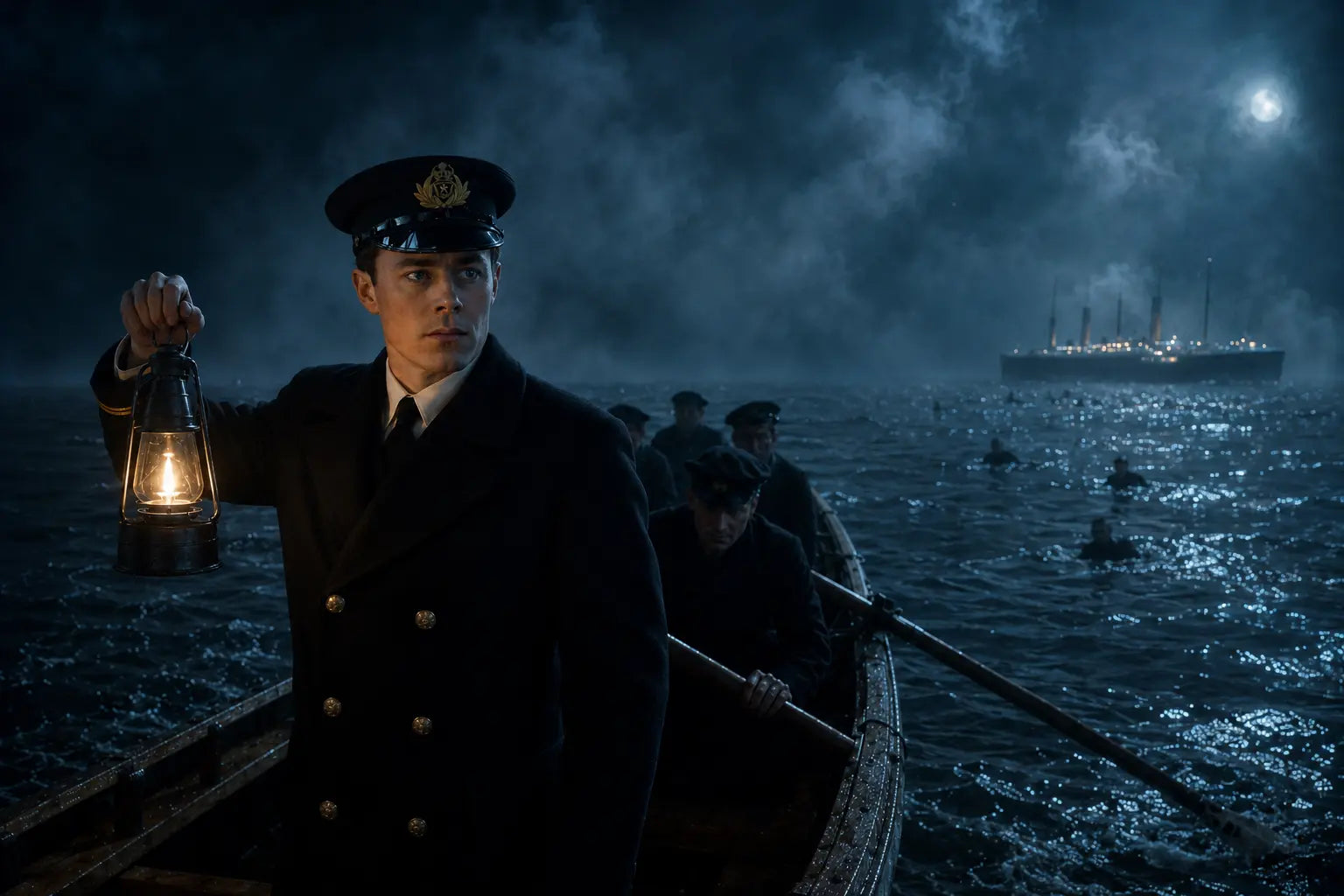
After emptying most of the boat, he formed a crew of volunteers and rowed back toward the wreckage. The men moved slowly among bodies, clothing and floating debris while calling for anyone still alive.
They found several survivors. One was Fang Lang, a Chinese passenger traveling in third class who was clinging to wreckage. Steward Harold Phillimore was also rescued, while William Hoyt died shortly after being pulled aboard.
➡️ In the darkness, every distant reflection could still represent hope. The Heart of the Ocean bracelet carries that blue light in a delicate design inspired by Titanic’s enduring story.
🌊 How Many People Did Harold Lowe Save?
There is no completely simple answer because the sources distinguish between people recovered directly from the water and survivors transferred from a damaged collapsible boat.
Harold Lowe stated that he found four people alive in the wreckage. Other testimony refers to three survivors and one man who died after being pulled aboard, which explains the slight differences between historical accounts.

Lifeboat No. 14 later approached Collapsible A. The boat was partially flooded and several people aboard had already died from exposure.
Lowe transferred the remaining survivors into his lifeboat. Modern reconstructions generally suggest that about a dozen people were still alive, although Lowe himself gave a higher estimate during his testimony.
His actions should therefore not be reduced to a single total. Lowe directly recovered several people from the water and then prevented more survivors from dying aboard a nearly submerged collapsible boat.
🔫 Did Harold Lowe Fire Warning Shots?
Yes. Harold Lowe acknowledged firing several revolver shots during the rescue operations. While Lifeboat No. 14 was being lowered, he stated that he fired along the side of the ship. Later, witnesses saw him fire into the air as the boat approached Collapsible A. None of the shots were intended to hit a person.
During the descent of Lifeboat No. 14, the boat was already heavily loaded. Lowe saw men gathered near the railings and feared that some might attempt to jump aboard.
He warned them verbally and then fired to make them step back. His stated intention was to prevent a sudden movement that could damage the lowering gear or overturn the boat.

When approaching Collapsible A, Lowe again used the revolver to warn the occupants to remain calm and avoid rushing toward one side of the boat.
His testimony also caused controversy because he initially assigned a nationality to the men he had seen near the railings. He later submitted a written statement acknowledging that he could not have known their nationality.
➡️ Harold Lowe’s determination was most visible during the evacuation’s most dangerous moments. The Heart of the Ocean earrings reflect that intensity through two luminous blue hearts inspired by the legend.
⚖️ His Testimony at the Titanic Inquiries
After reaching New York aboard the Carpathia, Harold Lowe testified before the United States Senate inquiry. He was later questioned in the United Kingdom during the British inquiry.
The investigators asked about his maritime experience, the lifeboats, ice warnings, the revolver shots and his decision to return to the wreck site.
Lowe answered confidently and sometimes sharply. He refused to provide details that he believed he could not verify, but firmly defended the decisions he had made.

He described the lowering of Lifeboat No. 14, the gathering of five boats and the transfer of his passengers. He also explained why he had waited before returning to the people in the water.
Regarding the shots, Lowe maintained that he had not aimed at anyone. He said that his purpose was to maintain order around a heavily loaded boat and later prevent dangerous movement during the rescue of Collapsible A.
Harold Lowe was never held responsible for the sinking. His testimony remains an important source for understanding the launching of the boats and the decisions made after the Titanic disappeared.
➡️ Survivor testimony preserved the human details of that night. The Heart of the Ocean ring continues that memory through a luminous blue heart designed to be worn close every day.
🏠 What Happened to Harold Lowe After the Titanic?
After the inquiries, Harold Lowe returned to Britain and resumed his maritime career. Although his actions attracted public attention, he did not attempt to build a public life around the Titanic.
In 1913, he married Ellen Marion Whitehouse. The couple had two children and later lived in Wales.
During the First World War, Lowe served in the Royal Naval Reserve. He reached the rank of commander and continued to use his experience as a professional officer and navigator.
After the war, he remained at sea for a time before retiring during the early 1930s. He eventually settled in Deganwy, near Conwy in North Wales.

The Titanic remained attached to his name, but Lowe generally lived quietly. He attended some commemorative events without actively presenting himself as a hero.
His actions are sometimes contrasted with those of Robert Hichens, commander of Lifeboat No. 6, whose refusal to return quickly became one of the evacuation’s most debated episodes.
🪦 Harold Lowe’s Death and Grave
Harold Lowe died in Deganwy on May 12, 1944. He was 61 years old.
His death was attributed to complications associated with high blood pressure. It occurred during the Second World War, more than 32 years after the Titanic disaster.
He was buried in the churchyard at Llandrillo-yn-Rhos, near Colwyn Bay. His gravestone bears his name, his Royal Naval Reserve titles and, lower down, the name of his wife, Ellen Marion Lowe.

The location is still visited by Titanic enthusiasts and maritime history researchers. It marks the final resting place of a man who returned to live in the region where his life had begun.
Harold Lowe’s grave is one of several memorial sites connected to the Titanic in Wales. It remains relatively modest, reflecting the quiet life he led after 1912.
🎬 Harold Lowe in Titanic (1997)
In James Cameron’s 1997 film Titanic, Harold Lowe is played by Welsh actor Ioan Gruffudd.
The character appears during the evacuation and later commands a lifeboat. After the sinking, he returns among the bodies and wreckage while calling for survivors with a lamp.
The sequence follows the essential historical event, although the movie simplifies the organization of the boats and the number of people rescued.
Lowe is shown finding Rose lying on a piece of wood. Because Rose is a fictional character, this part of the scene does not represent one of the people he actually found.

The film introduced Harold Lowe to millions of viewers and helped preserve the fact that one Titanic officer genuinely returned toward the wreck site. This meeting between historical fact and dramatic storytelling is also explored in our article marking the 25th anniversary of Titanic.
✨ Why Is Harold Lowe Remembered as a Titanic Hero?
Harold Lowe is often described as a Titanic hero because he was one of the few lifeboat commanders who returned toward the people in the water.
His decision required courage, but it also required preparation. He gathered several boats, redistributed his passengers and selected a crew before returning.
His conduct was not without controversy. His language during the inquiry and his use of a revolver attracted criticism. These details present Lowe as a complicated man rather than a flawless hero.

It is also important to remember that he waited before returning. By the time Lifeboat No. 14 reached the wreckage, most of the people in the water had already died from cold exposure.
Even so, Lowe acted when very few other commanders did. He accepted the risk of entering a dark field of bodies, ice and wreckage without knowing whether anyone could still be saved.
His story shows that courage does not always mean acting without fear. It can also mean making a measured decision when every available choice carries serious danger.
❓ Harold Lowe FAQ
Who was Harold Lowe on the Titanic?
Harold Godfrey Lowe was the fifth officer of the Titanic. He helped with the evacuation and commanded Lifeboat No. 14.
How old was Harold Lowe when the Titanic sank?
Harold Lowe was 29 years old when the Titanic sank during the night of April 14 and the early hours of April 15, 1912.
Did Harold Lowe survive the Titanic?
Yes. Harold Lowe survived aboard Lifeboat No. 14 and was later taken aboard the Carpathia.
Why did Harold Lowe return for survivors?
He wanted to search for people who were still alive in the water. Before returning, he transferred most of his passengers into other boats to create space and reduce the risk of capsizing.
How many people did Harold Lowe save?
Lowe stated that his boat found four people alive in the wreckage, although one died shortly afterward. Lifeboat No. 14 later rescued additional survivors from Collapsible A.
Did Harold Lowe shoot Titanic passengers?
No evidence shows that anyone was shot. Lowe admitted firing a revolver along the ship’s hull and later into the air, but stated that the shots were warnings rather than attempts to injure anyone.
Which Titanic lifeboat did Harold Lowe command?
Harold Lowe commanded Lifeboat No. 14, which was lowered from the port side of the Titanic.
Did Harold Lowe testify at the Titanic inquiries?
Yes. He testified before the United States Senate inquiry and later appeared before the British inquiry into the sinking.
Who played Harold Lowe in Titanic (1997)?
Harold Lowe was played by Welsh actor Ioan Gruffudd in James Cameron’s 1997 film.
Where is Harold Lowe buried?
Harold Lowe is buried in the churchyard at Llandrillo-yn-Rhos in North Wales.
🌟 Conclusion
Harold Lowe remains one of the most memorable officers in Titanic history. After helping with the evacuation, he commanded Lifeboat No. 14 and organized its return toward the wreckage.
Only a small number of people were found alive, but the operation was one of the few organized attempts to rescue those left in the water after the ship disappeared.
His testimony reveals an experienced, forceful and sometimes controversial officer. Lowe consistently defended his decisions and explained that he had tried to protect the people in his boat while saving anyone who could still be reached.
In the 1997 movie, Lowe’s return became one of the sinking’s most memorable scenes. In the historical record, his action remains the choice of an officer who went back toward the cries while almost every other lifeboat stayed away.

📚 Sources and References
- Harold Lowe’s testimony before the United States Senate inquiry
- Harold Lowe’s testimony before the British inquiry
- Harold Lowe’s supplementary statement to the United States inquiry
- Harold Godfrey Lowe biography published by Encyclopedia Titanica
*The visuals featured in this article are original reconstructions created by our team with the assistance of artificial intelligence tools. Produced for editorial purposes, they are not photographs or archival documents.