
Table of Contents
📘 Introduction
Benjamin Guggenheim is one of the most fascinating passengers in the history of the Titanic. His name is often associated with one of the most striking stories of the disaster: the wealthy American millionaire who reportedly chose to face the end of the ship dressed in evening wear.

Today, many people search online for answers about him. Who was Benjamin Guggenheim? Why was he traveling on the Titanic? What were his last words? And is it true that he became known as the millionaire who dressed for death?
Born into one of the most powerful industrial families in the United States, Benjamin Guggenheim lived a life surrounded by wealth, travel, and high society. As a member of the famous Guggenheim family, he belonged to the elite class of passengers who frequently crossed the Atlantic between Europe and America.
When the RMS Titanic began its maiden voyage in April 1912, Guggenheim was traveling in first class, accompanied by members of his personal entourage. Like the other wealthy passengers on board, he had no reason to believe that the journey would end in one of the most famous maritime disasters in history.
Yet what made Benjamin Guggenheim famous was not only his fortune. It was the way he reportedly reacted when the situation became hopeless. According to several witnesses, he changed into formal evening clothes and calmly waited on deck as the ship prepared to sink.

More than a century later, the story of Benjamin Guggenheim on the Titanic continues to fascinate historians, Titanic enthusiasts, and readers around the world. His story illustrates both the tragedy of the disaster and the quiet dignity shown by some passengers during the final hours of the ship.
🧑💼 Who was Benjamin Guggenheim?
Benjamin Guggenheim was an American businessman and millionaire who became one of the most memorable passengers associated with the Titanic disaster. Although he belonged to one of the richest families in the United States, his name is remembered today mainly because of his behavior during the final hours of the ship.
Benjamin Guggenheim was born on October 26, 1865, in Philadelphia. He was the son of Meyer Guggenheim, the founder of a vast industrial empire built around mining and metal production. The Guggenheim family controlled important silver, copper, and lead mining operations across the United States and abroad.
Growing up in such a powerful and wealthy environment meant that Benjamin Guggenheim lived a life surrounded by privilege. Unlike some of his brothers who were deeply involved in managing the family business, he was known for a more social and cosmopolitan lifestyle.

He frequently traveled between Europe and the United States, spending long periods abroad while maintaining connections with high society on both continents. Transatlantic travel was common among wealthy Americans at the beginning of the twentieth century, and luxury ocean liners were the preferred way to cross the Atlantic.
By the time he boarded the RMS Titanic in April 1912, Benjamin Guggenheim was already a well-known member of the American elite. Traveling in first class, he represented the type of affluent passenger for whom the Titanic had been designed: wealthy, internationally connected, and accustomed to the comfort of the most prestigious ocean liners.
However, the tragic events of the Titanic's maiden voyage would transform Benjamin Guggenheim from a wealthy traveler into one of the most talked-about figures of the disaster. His story would later become part of the enduring legend of the Titanic.
➡️ More than a century later, the Titanic remains one of the most fascinating stories ever told. Its legend inspired the iconic Heart of the Ocean necklace.
🏛️ The Guggenheim family: an American industrial dynasty
To understand who Benjamin Guggenheim was, it is important to look at the remarkable history of the Guggenheim family, one of the most powerful industrial dynasties in the United States during the late nineteenth and early twentieth centuries.
The family's fortune was built by Meyer Guggenheim, a Swiss-born immigrant who arrived in the United States in the mid-1800s. Through strategic investments in mining and metal refining, he gradually created a vast industrial empire.
The Guggenheims became major players in the extraction of silver, copper, and lead, operating mines throughout the American West as well as in parts of South America. Their companies controlled significant portions of the global metal supply at the time, which allowed the family to accumulate enormous wealth.
As the business expanded, Meyer Guggenheim involved his sons in the family enterprises. Several of them played key roles in managing the mining and smelting operations, turning the Guggenheim name into a symbol of industrial success in the United States.

Over time, the influence of the Guggenheim family extended beyond industry. Later generations would become famous for their involvement in art patronage and cultural institutions. The name Guggenheim is now closely associated with renowned museums, including the Solomon R. Guggenheim Museum in New York and the Guggenheim Museum in Bilbao.
Benjamin Guggenheim, however, followed a somewhat different path from some of his brothers. While he remained part of the wealthy Guggenheim circle, he was known more for his social life, international travel, and presence in elite society than for direct involvement in the management of the family empire.
This lifestyle of frequent travel between Europe and America helps explain why he found himself aboard the Titanic in April 1912, embarking on what would become one of the most tragic voyages in maritime history.
💰 How wealthy was Benjamin Guggenheim?
Many readers interested in the history of the Titanic wonder just how wealthy Benjamin Guggenheim really was. As a member of the powerful Guggenheim family, he belonged to one of the richest industrial dynasties of the early twentieth century.
The Guggenheim fortune originated from mining and metal refining businesses that expanded rapidly during the late nineteenth century. Under the leadership of Meyer Guggenheim and his sons, the family developed major operations in silver, copper, and lead mining, controlling vast industrial resources across North and South America.
While it is difficult to determine Benjamin Guggenheim's personal wealth precisely, historians generally agree that he possessed a fortune that placed him among the American financial elite of his era.

At the beginning of the twentieth century, even a few million dollars represented extraordinary wealth. Adjusted for modern inflation, the Guggenheim family fortune would be worth billions of dollars today.
This immense wealth allowed Benjamin Guggenheim to live a life defined by luxury and international travel. He regularly crossed the Atlantic, stayed in prestigious hotels, and maintained a lifestyle typical of the global upper class of the period.
It is therefore no surprise that when he boarded the RMS Titanic in April 1912, he traveled in first class, surrounded by other prominent figures of the time. Among them were some of the wealthiest passengers ever to sail on an ocean liner, including John Jacob Astor and other members of high society.
Yet despite his immense fortune and privileged position, Benjamin Guggenheim would ultimately share the same tragic fate as many other passengers during the Titanic disaster.
➡️ Even today, the legend of the Titanic continues to inspire iconic jewels. The Heart of the Ocean bracelet carries a touch of that timeless elegance.
🚢 Why was Benjamin Guggenheim on the Titanic?
In the spring of 1912, Benjamin Guggenheim had been spending time in Europe, as he often did during his travels. Wealthy Americans of his social class frequently crossed the Atlantic, dividing their lives between Europe and the United States.
Ocean liners were the primary means of long-distance travel at the time, and the launch of the RMS Titanic attracted enormous attention among elite travelers. Advertised as the largest and most luxurious ship ever built, the Titanic represented the pinnacle of comfort and prestige in transatlantic travel.
When Guggenheim decided to return to the United States, he chose to sail aboard the Titanic during its maiden voyage. Like many members of high society, he booked accommodations in first class, where passengers enjoyed spacious cabins, fine dining, and lavish public rooms.

Benjamin Guggenheim boarded the ship at Southampton on April 10, 1912. He was traveling with members of his personal entourage, including his valet Victor Giglio and his secretary.
For passengers like Guggenheim, the voyage was expected to be a comfortable and prestigious crossing to New York. The Titanic was widely considered unsinkable, and few could imagine that the journey would end in tragedy only a few days later.
As a wealthy and internationally connected traveler, Benjamin Guggenheim perfectly represented the type of passenger for whom the Titanic had been designed: affluent, cosmopolitan, and accustomed to the luxury of the world's most advanced ocean liners.
However, what began as a routine transatlantic journey would soon become one of the most dramatic maritime disasters in history.
💃 Benjamin Guggenheim's mistress on the Titanic
Another intriguing detail frequently mentioned in accounts of the Titanic disaster concerns the woman who was traveling with Benjamin Guggenheim during the voyage.
Guggenheim was accompanied by Léontine Aubart, a French singer with whom he had a romantic relationship. Officially, she was introduced to others on board as his secretary, a description that helped avoid scandal within the conservative social norms of the early twentieth century.
In reality, many historians believe that Aubart was Guggenheim's companion during his stay in Europe and on the transatlantic journey. Traveling with a companion was not unusual among wealthy men of the era, especially when they spent long periods abroad.

When the Titanic struck the iceberg late on the night of April 14, 1912, chaos gradually began spreading throughout the ship as passengers tried to understand what had happened.
Léontine Aubart was eventually brought to the boat deck and placed in one of the lifeboats reserved for women and children. Like many female passengers traveling in first class, she was given priority during the evacuation.
She survived the sinking of the Titanic and later provided valuable testimony about the events of that night. Her account helped historians better understand the final moments of Benjamin Guggenheim aboard the ship.
While Aubart escaped the disaster, Guggenheim remained on board, facing the tragic fate that awaited many passengers during the final hours of the Titanic.
➡️ More than a century later, the elegance of Titanic’s first-class passengers still inspires timeless jewelry. The Heart of the Ocean earrings capture a touch of that legendary glamour.
🎩 The millionaire who dressed for death
The episode that made Benjamin Guggenheim one of the most memorable figures of the Titanic disaster occurred during the final phase of the evacuation, when it became increasingly clear that the ship would not survive the night.
After the collision with the iceberg on April 14, 1912, many passengers initially believed that the situation was under control. However, as the crew began preparing the lifeboats, the reality of the disaster slowly became apparent.
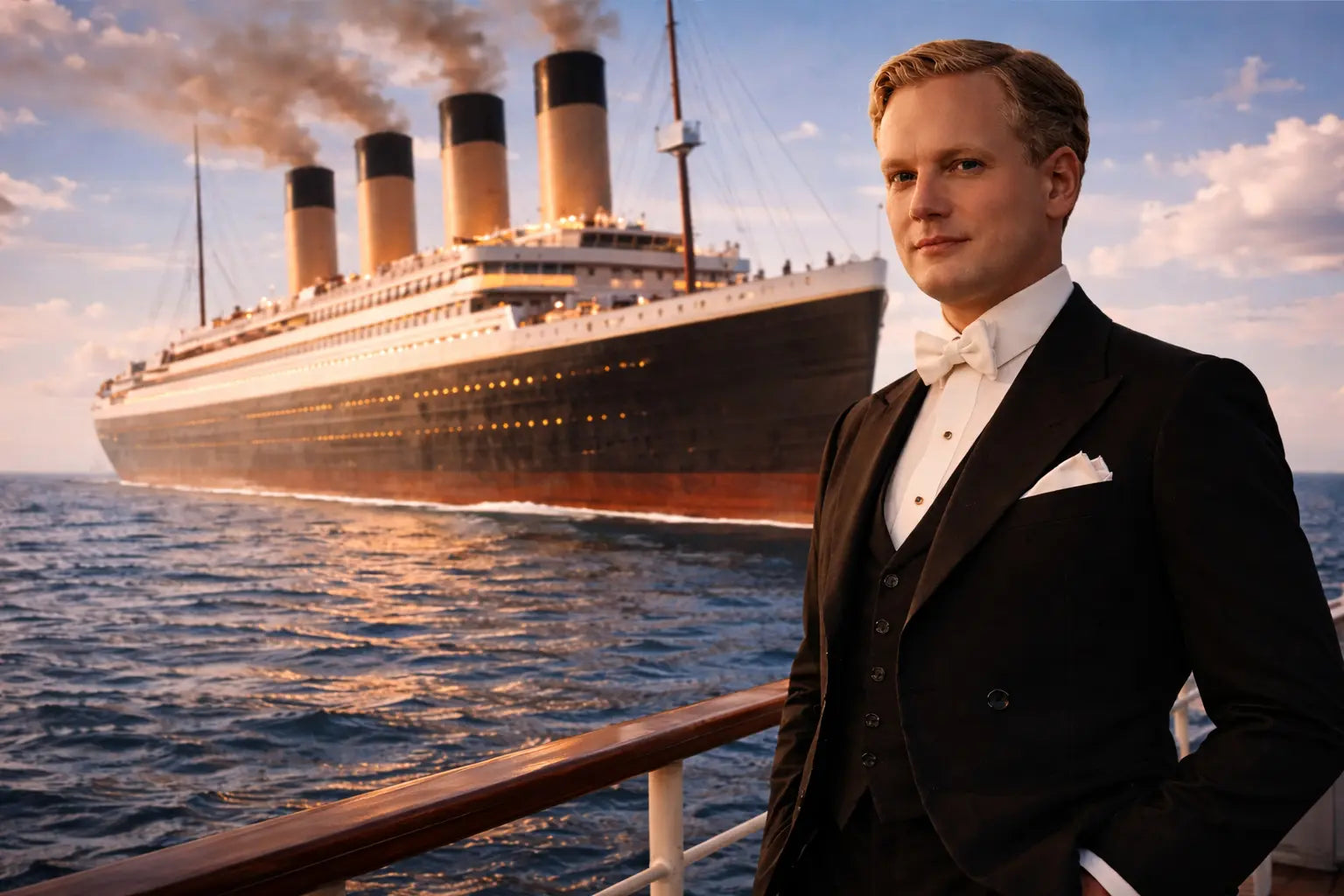
At some point during the evacuation, Benjamin Guggenheim reportedly returned to his cabin with his valet, Victor Giglio. Instead of attempting to secure a place in a lifeboat, the two men changed into formal evening clothes.

Witnesses later described seeing Guggenheim back on deck wearing a tuxedo and evening attire, calmly observing the unfolding events around him.
According to several accounts, Guggenheim explained that he wished to be properly dressed to face death. This decision gave rise to one of the most famous expressions associated with the Titanic tragedy: the story of the "millionaire who dressed for death".
In a moment when fear and confusion were spreading across the ship, Guggenheim's composed behavior left a strong impression on survivors. His calm attitude, combined with his elegant appearance, symbolized the ideal of dignity and self-control often associated with gentlemen of that era.
Although historians debate the precise details of the scene, the image of Benjamin Guggenheim standing on deck in evening wear has become one of the most enduring stories of the Titanic.
🕯️ The last words of Benjamin Guggenheim
Among the many stories told about the final hours of the Titanic, one of the most famous concerns the last words of Benjamin Guggenheim.
According to testimonies from crew members and survivors, Guggenheim asked a steward to deliver a message to his wife in New York after the disaster.
The message reportedly said:
"Tell my wife that I have done my best in doing my duty. No man can do more than that."
This sentence has become one of the most quoted statements associated with the Titanic tragedy. Whether repeated exactly as spoken or slightly altered through retelling, it reflects the sense of duty that many witnesses attributed to Guggenheim during the final moments of the ship.

By this stage of the disaster, it had become clear that there would not be enough lifeboats for everyone on board. Following the maritime tradition often summarized as "women and children first", many male passengers stepped aside to allow others to escape.
According to the accounts that survived the tragedy, Benjamin Guggenheim accepted this reality with remarkable composure. His message to his wife suggests that he saw his actions as fulfilling his responsibility in the face of an unavoidable catastrophe.
More than a century later, these words continue to be associated with the story of the Titanic passenger who chose dignity over panic.
➡️ Stories from the Titanic continue to echo through time. The Heart of the Ocean ring carries a hint of that same timeless romance.
🌊 How did Benjamin Guggenheim die on the Titanic?
When the RMS Titanic finally sank in the early hours of April 15, 1912, Benjamin Guggenheim was still on board the ship.
By that stage of the disaster, the situation had become hopeless. Most of the lifeboats had already been launched, and hundreds of passengers remained on deck as the bow of the Titanic gradually slipped beneath the freezing waters of the North Atlantic.
Several testimonies suggest that Guggenheim was last seen on one of the upper decks of the ship, still dressed in his evening clothes. Alongside his valet Victor Giglio, he reportedly remained calm as the final moments of the vessel approached.
At around 2:20 a.m., the Titanic broke apart and disappeared beneath the ocean. Hundreds of passengers were suddenly thrown into the icy water.

The temperature of the Atlantic that night was close to -2°C (28°F). In such extreme conditions, most people in the water succumbed to hypothermia within minutes.
Like many other victims of the disaster, Benjamin Guggenheim most likely died shortly after entering the freezing water following the sinking of the ship.
His composed behavior during the final hours of the Titanic became one of the most widely remembered stories of the tragedy, symbolizing the calm determination shown by some passengers in the face of inevitable catastrophe.
⚓ Was Benjamin Guggenheim's body ever found?
After the sinking of the Titanic, several ships were sent to the disaster area to recover the bodies of victims floating in the North Atlantic.
The main recovery vessel was the CS Mackay-Bennett, chartered by the White Star Line shortly after the tragedy. Its crew was tasked with locating and retrieving as many victims as possible from the waters where the Titanic had sunk.
Over the course of several days, the Mackay-Bennett and other ships recovered more than 300 bodies from the ocean. Many victims were later identified and returned to their families for burial.

However, despite these extensive search efforts, the body of Benjamin Guggenheim was never found.
Like many passengers who perished during the disaster, he disappeared into the depths of the Atlantic. Today, historians believe that his remains most likely rest somewhere near the wreck site of the Titanic.
The absence of a recovered body has added to the almost legendary aura surrounding his story. Benjamin Guggenheim is therefore remembered not through a grave, but through the testimonies and historical records that describe his final moments on board the ship.
More than a century after the tragedy, his name continues to appear among the most famous victims of the Titanic disaster.
🎬 Benjamin Guggenheim in James Cameron's Titanic
The story of Benjamin Guggenheim also appears in the famous film Titanic directed by James Cameron, released in 1997. Although the movie mainly follows fictional characters, it also includes several real passengers who were on board the ship.
James Cameron carefully integrated historical figures into the narrative in order to recreate the atmosphere and social structure of the Titanic. Wealthy passengers, crew members, and prominent individuals from the disaster appear throughout the film.
Benjamin Guggenheim is briefly represented in a scene showing elegantly dressed first-class passengers calmly waiting as the situation on the ship becomes increasingly desperate.

The scene reflects the historical accounts describing Guggenheim returning to the deck in evening attire after changing clothes with his valet. The film does not focus extensively on his story, but the reference helps illustrate the behavior of certain passengers during the final moments of the Titanic.
By including figures such as Guggenheim, John Jacob Astor, Thomas Andrews, and other real individuals, the film helped introduce millions of viewers to the true stories behind the Titanic disaster.
For many people around the world, James Cameron's Titanic was the first time they encountered the name of Benjamin Guggenheim and learned about the legendary story of the millionaire associated with the ship's tragic final hours.
💎 Why Benjamin Guggenheim became a Titanic legend
More than a century after the Titanic disaster, the story of Benjamin Guggenheim continues to fascinate historians, readers, and Titanic enthusiasts around the world.
While many wealthy passengers traveled on the Titanic, Guggenheim's name stands out because of the remarkable attitude he reportedly displayed during the ship's final hours.
According to witness accounts, he chose not to fight for a place in a lifeboat. Instead, he stepped aside while evacuation procedures prioritized women and children.

The image of Guggenheim calmly returning to the deck dressed in formal evening clothes has become one of the most enduring symbols of dignity associated with the Titanic tragedy.
Whether every detail of the story is perfectly accurate or partly shaped by later retellings, the legend of the "millionaire who dressed for death" reflects the way survivors remembered his behavior during the disaster.
Stories like this help explain why certain passengers have become iconic figures of the Titanic. Their actions during the final hours of the ship provide a human dimension to the tragedy, turning historical events into powerful narratives that continue to resonate today.
Benjamin Guggenheim's story therefore remains an important part of the broader memory of the Titanic, alongside the accounts of other passengers and crew members whose experiences have shaped our understanding of the disaster.
❓ FAQ about Benjamin Guggenheim and the Titanic
Who was Benjamin Guggenheim?
Benjamin Guggenheim was an American businessman and millionaire who belonged to the wealthy Guggenheim family. He became widely known as one of the first-class passengers who died during the Titanic disaster in 1912.
Why was Benjamin Guggenheim on the Titanic?
Benjamin Guggenheim had been traveling in Europe and chose to return to the United States aboard the RMS Titanic during its maiden voyage in April 1912. Like many wealthy travelers of the time, he frequently crossed the Atlantic on luxury ocean liners.
What were Benjamin Guggenheim's last words?
According to survivor testimonies, Benjamin Guggenheim asked a steward to deliver a message to his wife saying: "Tell my wife that I have done my best in doing my duty. No man can do more than that."

Did Benjamin Guggenheim try to escape the Titanic?
Historical accounts suggest that Guggenheim did not attempt to secure a place in a lifeboat. Instead, he reportedly stepped aside while evacuation procedures prioritized women and children.
Why is Benjamin Guggenheim called the millionaire who dressed for death?
Witnesses reported that Guggenheim returned to his cabin during the evacuation and changed into formal evening clothes before going back to the deck. This story led to the famous description of him as the "millionaire who dressed for death".
Was Benjamin Guggenheim's body ever found?
No. Despite the recovery efforts conducted after the sinking of the Titanic, the body of Benjamin Guggenheim was never recovered.
Did Benjamin Guggenheim appear in the Titanic movie?
Yes. The character of Benjamin Guggenheim appears briefly in James Cameron's Titanic (1997), which included several real passengers from the ship in its historical scenes.
✨ Conclusion: the quiet courage of a Titanic passenger
The story of Benjamin Guggenheim is one of the many human stories that continue to shape the legacy of the Titanic disaster. Among the more than two thousand passengers and crew members who sailed aboard the famous ocean liner in April 1912, each person had their own journey, their own fears, and their own choices during the final hours of the ship.

What makes Guggenheim's story particularly memorable is the image that has remained in collective memory: that of a wealthy passenger who faced the tragedy with calm and dignity. Whether every detail of the story has been perfectly preserved by history or partly shaped by later retellings, the narrative reflects the way survivors remembered the atmosphere of that night.
The Titanic disaster continues to fascinate people more than a century later because it brings together technology, ambition, human drama, and powerful personal stories. Passengers such as Benjamin Guggenheim, John Jacob Astor, and many others have become part of a historical memory that still captures the imagination today.
By exploring the lives of these passengers, we gain a deeper understanding of what happened during the sinking of the Titanic. Beyond the ship itself, it is the stories of the people on board that continue to keep the history of the Titanic alive for new generations.
More than a century later, the legend of the Titanic remains a powerful reminder of how individual choices, courage, and humanity can define the memory of one of the most famous maritime disasters in history.

*The visuals featured in this article are original illustrations created by our editorial team with the assistance of artificial intelligence tools. They do not depict the actual people mentioned and do not reproduce any copyrighted material.