
Table of Contents
🕯️ Introduction
Isidor and Ida Straus remain one of the most searched real-life stories connected to the RMS Titanic. Online, they are often identified as the "elderly couple on the Titanic" or through questions like "Was the old couple in Titanic real?" and "What happened to the Straus couple?". Behind those searches lies a story that feels almost impossible in the context of disaster: they chose not to be separated.
Unlike other well-known Titanic passengers whose names are associated with wealth, controversy, or dramatic heroism, the Straus legacy rests on a quieter foundation. It is not built on spectacle. It is built on consistency. Married for more than four decades, they faced the final hours of the sinking together, when fear and uncertainty ruled the decks.

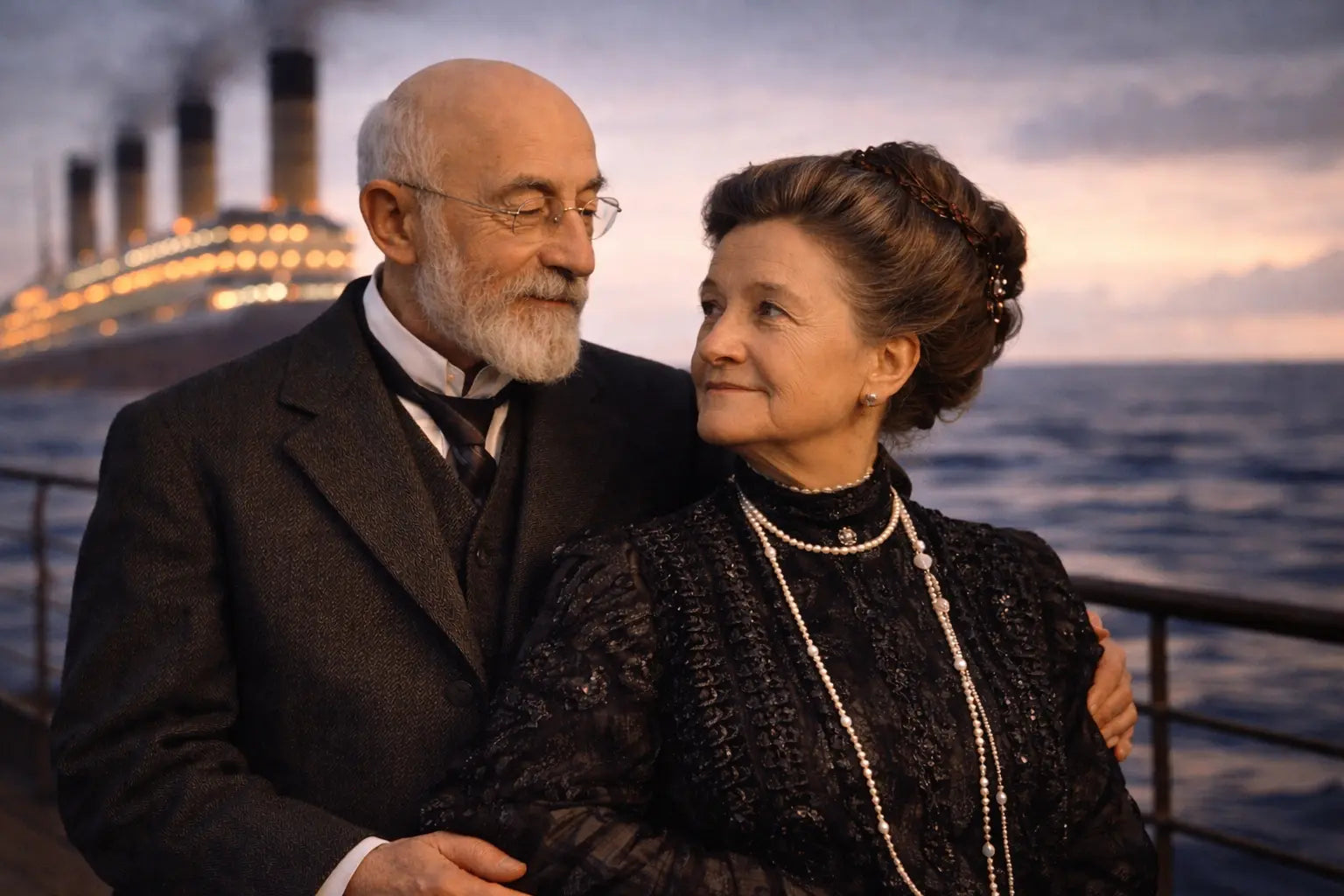
Over time, their story became intertwined with an iconic image: an older couple embracing as water rises inside the ship. That scene, popularized by cinema, has led many to wonder whether it reflects historical truth or artistic interpretation. The distinction matters, especially for readers seeking the true story of the Straus Titanic couple rather than a romanticized retelling.
This article examines:
- Documented facts supported by survivor testimonies and official inquiries,
- Details frequently repeated but not always traceable to primary sources,
- The origins of the elderly Titanic couple legend in popular culture.
More than a tragic footnote, their decision became one of the most enduring symbols of devotion linked to the Titanic. It is a story that continues to resonate because it speaks to something universal: loyalty that does not yield to circumstance.
➡️ A heart resting at the base of the neck, catching every ray of light: the Heart of the Ocean necklace embodies timeless depth and brilliance.
👥 Who Were Isidor and Ida Straus?
Isidor Straus was born in 1845 in Germany and immigrated to the United States as a child. His family settled in the American South before eventually moving to New York, where he and his brother would play a central role in developing one of the most recognizable retail institutions in American history: Macy's. By the early twentieth century, Isidor Straus was not only a successful businessman but also a respected public figure, briefly serving in the U.S. House of Representatives.
Ida Straus, born Ida Blun in 1849, shared neither the public spotlight nor the political stage, yet her presence in her husband's life was constant and deeply influential. Those who knew the couple described their marriage as affectionate, steady, and unusually close for the era. Married in 1871, they had seven children and were widely recognized in New York society for both their prosperity and their philanthropy.

By April 1912, when they boarded the RMS Titanic, Isidor was 67 years old and Ida was 63. They were returning to New York after spending time in Europe. Traveling in first class, accompanied by their personal maid, they belonged to the upper tier of Titanic passengers, a group that included prominent industrialists, financiers, and social elites.
Yet unlike other well-known first-class names such as John Jacob Astor or Captain Edward John Smith, the Straus legacy would not be defined by status or authority. It would be defined by a personal decision made in the final hours of the sinking.
Today, searches such as "Isidor Straus Titanic passenger" and "who was the elderly couple on Titanic?" continue to lead readers back to their story. Understanding who they were before the disaster is essential to understanding why their final choice carried such lasting symbolic weight.

📜 Their Life Before the Titanic
Long before the tragedy of 1912, Isidor and Ida Straus had already built a life that reflected stability, influence, and long-standing partnership. Their story did not begin with the Titanic. It began decades earlier, in a rapidly expanding America where commerce, politics, and philanthropy were reshaping society.
After immigrating to the United States, Isidor Straus worked alongside his brother Nathan to expand Macy's department store into one of New York's most important commercial institutions. Under their leadership, Macy's grew into a retail empire symbolizing innovation and modern urban life. By the early twentieth century, Isidor Straus was widely recognized not only as a businessman but also as a civic leader.

The couple's influence extended beyond business. The Straus family supported educational initiatives, charitable foundations, and public causes. Their philanthropy reflected a belief in civic responsibility that was common among prominent families of the era, yet their reputation was distinguished by discretion rather than display.
Married for over forty years, Isidor and Ida were known for their close companionship. Ida frequently accompanied her husband on travel and social engagements, and contemporaries often remarked on the visible bond between them. Their partnership was not merely formal or strategic. It was personal and enduring.
By April 1912, the Straus family occupied a respected place within American society. Boarding the RMS Titanic as first-class passengers was consistent with their status, yet there was nothing extravagant or reckless about the journey. Like many prominent travelers, they saw the Titanic as a modern marvel, a vessel widely regarded as safe, efficient, and technologically advanced.
In hindsight, their decades-long marriage would shape the meaning of their final hours. The values that defined their life together, loyalty, steadiness, and shared purpose, would soon be tested under circumstances no one aboard the Titanic could have anticipated.
➡️ Discover Molly Brown, the legendary "Unsinkable" passenger whose courage and leadership left a lasting mark on the history of the RMS Titanic.
🌊 The Night of the Sinking - What We Know
On the night of April 14, 1912, the RMS Titanic struck an iceberg in the North Atlantic. In the first moments after the collision, confusion outweighed panic. Many first-class passengers, including Isidor and Ida Straus, initially believed the interruption would be temporary.
As crew members began organizing evacuation procedures, the long-standing maritime rule was enforced: women and children first. Ida Straus was offered a seat in a lifeboat. At that point, survival remained possible.

Multiple survivor testimonies agree on a defining detail. Isidor Straus refused to board a lifeboat while other women and children remained on deck. According to accounts later recorded during inquiries, he did not wish to take advantage of his social position.
The question most frequently searched today, "Did Ida Straus refuse the lifeboat?", is answered by consistent testimony. After her husband declined to leave, Ida chose to remain with him. Witnesses recalled her saying that they had lived together for many years and would not be separated now. The exact wording varies across sources, but the meaning remains clear.
The phrase "Ida Straus lifeboat refusal" has become one of the most enduring elements of Titanic history. What makes it powerful is not drama, but deliberation. She was not prevented from boarding. She was not unaware of the danger. She made a conscious decision.
Survivors later reported seeing the couple seated together on deck as the ship listed further into the freezing Atlantic night. Unlike the cinematic image of an elderly couple in their cabin, historical accounts place them outdoors, side by side, composed despite the escalating chaos.
When the Titanic finally sank in the early hours of April 15, 1912, Isidor and Ida Straus perished together. Isidor's body was later recovered and identified. Ida's was never found.
For those searching "what happened to the elderly couple on Titanic?", the answer is tragically simple: they had the opportunity to survive apart, and they chose not to.
➡️ Discover Ruth Becker, one of the youngest survivors of the RMS Titanic, and explore how her life was shaped by the events of April 1912.
🤍 Why Ida Straus Refused the Lifeboat
The defining moment of the Straus story centers on a simple yet irreversible choice. When a lifeboat seat was made available to Ida Straus, she had the opportunity to leave the ship and survive. As a first-class female passenger, she fell directly under the evacuation priority of "women and children first."
Historical testimony consistently confirms that Ida Straus refused to board without her husband. While the exact wording attributed to her differs slightly between witnesses, the essence of her response remains consistent across sources: after decades of marriage, she would not abandon him in his final hours.

Modern readers often search for "Why did Ida Straus refuse the lifeboat?" The answer appears rooted in the nature of their relationship. Married for more than forty years, the Straus partnership was widely regarded as unusually close. Ida frequently accompanied Isidor on business trips and social engagements, and long separations were rare.
Another frequently mentioned detail involves their maid, Ellen Bird. According to several accounts, Ida encouraged her maid to take the available seat instead. This gesture reinforced the perception that her decision was not impulsive or confused, but deliberate and composed.
It is important to understand the context. By the time this decision was made, the seriousness of the situation was becoming increasingly clear. Lifeboats were limited. The angle of the deck was beginning to shift. Remaining aboard the Titanic was not a passive outcome. It was an active acceptance of risk.
The story of the elderly Titanic couple endures not because it is dramatic, but because it reflects a lifetime of consistency. In that moment, Ida Straus acted in alignment with the values that had defined her marriage: loyalty, unity, and shared fate.
➡️ A light that circles the wrist with quiet intensity: the Heart of the Ocean bracelet captures elegance in every movement.
🚤 Fact vs Legend - The Elderly Titanic Couple
Few Titanic images are as emotionally powerful as that of an elderly couple embracing as water floods their cabin. For many viewers, this scene defines the sinking. It is therefore common to encounter questions such as "Was the old couple in Titanic real?" or "Did the Straus die in their cabin?"
The answer requires nuance. The 1997 film Titanic presents a brief but unforgettable image of an older couple holding each other in bed while water rises around them. Although the characters are unnamed, the scene is widely interpreted as being inspired by Isidor and Ida Straus.

However, historical evidence does not confirm that the Straus couple remained in their cabin during the final moments. Survivor testimonies place them on deck, seated side by side, as the ship continued to list. The widely shared "bed scene" belongs primarily to cinematic storytelling rather than documented record.
This distinction matters. The real story of the elderly Titanic couple is not diminished by removing dramatic embellishment. If anything, it becomes more compelling. Instead of a private final scene hidden below deck, witnesses describe a composed public presence, two individuals facing inevitability together.
It is also important to separate verified details from repetition. While many online articles confidently assert that the Straus couple died in their stateroom, no primary inquiry report confirms that location. What is consistently supported by testimony is that they were last seen together on the open deck.
The enduring power of the legend lies not in whether they were indoors or outdoors, but in the consistency of their decision. Whether in a cabin or beneath the open sky, the essential truth remains unchanged: they refused to be separated.
➡️ Learn more about Charlotte Drake Cardeza, one of the wealthiest first-class passengers aboard the RMS Titanic, and discover the remarkable story behind her survival.
🎬 Was the Old Couple in Titanic Real?
One of the most frequently asked questions online is simple: "Was the old couple in Titanic real?" The 1997 film directed by James Cameron includes a short but deeply emotional moment showing an elderly couple embracing in their cabin as water rises. For many viewers, that image represents the quiet tragedy of the sinking.
Although the characters are never identified on screen, the scene is widely understood to be inspired by the real-life story of Isidor and Ida Straus. Cameron's film does not attempt a documentary reconstruction, but rather a symbolic tribute to one of the most poignant accounts from the night of April 14-15, 1912.

Historically, as documented in survivor testimony, the Straus couple were last seen seated together on deck rather than inside their cabin. Yet the emotional truth captured by the film aligns with the documented facts: they remained side by side until the end.
The difference between cinema and history often raises debate. Some viewers assume the film scene is a literal depiction of their final moments. Others question whether the elderly Titanic couple scene was fictional. The most accurate conclusion is this: the film dramatizes the setting, but the core decision, their refusal to be separated, is firmly rooted in historical record.
In this way, popular culture did not invent the Straus legacy. It amplified it. The cinematic version introduced their story to a global audience, transforming archival testimony into a universally recognized symbol of devotion.
➡️ A symbol worn close to the heart, reflecting depth and meaning: discover the Heart of the Ocean ring.
🕊️ Legacy and Memorials
The deaths of Isidor and Ida Straus resonated far beyond the sinking of the RMS Titanic. In New York, where the Straus family was widely known for both business leadership and philanthropy, the news was met with profound public mourning.
Isidor Straus's body was recovered several weeks after the disaster by the cable ship Mackay-Bennett. He was identified and returned to New York, where his funeral drew political leaders, business figures, and members of the public. His gravesite remains a point of historical interest for those researching Isidor Straus grave Titanic or Titanic victims buried in New York.
Ida Straus's body was never recovered. Like many Titanic victims, she was lost to the Atlantic. Yet her absence did not diminish her presence in collective memory.
In Manhattan, Straus Park was established in their honor. The memorial fountain bears an inscription commemorating their shared fate, emphasizing Ida's decision to remain with her husband. Today, searches such as "Straus Park Titanic memorial" continue to guide visitors and researchers to this quiet but meaningful site.

Unlike some Titanic narratives marked by controversy or debate, the Straus legacy has remained remarkably consistent. Their story has been remembered not for conflict, but for unity. Over a century later, their names still appear whenever people search for the elderly couple who refused to leave the Titanic.
Memory does not always preserve every factual detail with precision, but in this case, the central truth has endured: they chose to face the end together.
➡️ Explore more real stories from the Titanic, including historical reflections on the Titanic legacy.
❓ FAQ - Isidor and Ida Straus Titanic
Were Isidor and Ida Straus real Titanic passengers?
Yes. Isidor and Ida Straus were real first-class passengers aboard the RMS Titanic in April 1912. Isidor was co-owner of Macy's department store in New York, and the couple was widely known for their philanthropy and long-standing marriage.
Did Ida Straus refuse a lifeboat?
According to survivor testimonies, Ida Straus was offered a seat in a lifeboat but chose not to board without her husband. This decision has become one of the most frequently cited examples of devotion associated with the Titanic.
Why did Isidor Straus not get into a lifeboat?
Reports indicate that Isidor Straus declined to board while women and children were still awaiting evacuation. He did not wish to take advantage of his social position or age to secure a place.
Was the elderly couple in the movie Titanic based on them?
The elderly couple shown embracing in the 1997 film Titanic is widely believed to be inspired by the Straus story. However, the film dramatizes their final setting. Historical testimony places the Straus couple on deck rather than inside their cabin.
Did Isidor and Ida Straus die together?
Yes. Survivor accounts confirm that they were last seen seated side by side on the deck as the ship continued to sink. They perished during the early hours of April 15, 1912.
Was Isidor Straus's body recovered?
Isidor Straus's body was recovered several weeks after the sinking and returned to New York for burial. Ida Straus's body was never found.

What makes their story so famous?
The story of the elderly Titanic couple endures because it represents a deliberate choice. They had the possibility to survive separately. They chose to remain together. That decision transformed their personal tragedy into a lasting symbol of loyalty and unity.
✨ Conclusion
The story of Isidor and Ida Straus does not rely on spectacle, controversy, or dramatic heroism. It rests on continuity. A marriage built over decades, affirmed in a single irreversible night aboard the RMS Titanic.

In the broader history of the Titanic, some names are associated with wealth, others with command, and others with controversy. The legacy of the Straus couple is defined differently. It is defined by a quiet decision that continues to resonate more than a century later.
For those searching for the true story of the elderly couple on the Titanic, the historical record confirms something both simple and profound: they were given the opportunity to survive apart. They chose unity instead.
Their memory endures not because of embellishment, but because of coherence. Their final act was consistent with the life they had shared, steady, loyal, and inseparable.
In the enduring narrative of the Titanic, their story remains a reminder that the most powerful moments are sometimes the quietest ones.

*The visuals featured in this article are original illustrations created by our editorial team with the assistance of artificial intelligence tools. They do not depict the actual people mentioned and do not reproduce any copyrighted material.