
Table of Contents
🕯️ Introduction
J. Bruce Ismay remains one of the most controversial survivors of the Titanic. As chairman of the White Star Line, the company behind the ship, he was on board during the maiden voyage in April 1912. When the liner sank in the North Atlantic, more than 1,500 people lost their lives. Ismay survived.

That survival followed him for the rest of his life. To some, Bruce Ismay became the man who should have stayed on board. To others, he was a traumatized survivor turned into a scapegoat by the press, by public anger and by a society searching for someone to blame.
So, was J. Bruce Ismay a coward? How did he survive the Titanic? Why was he blamed after the sinking? What happened to J. Bruce Ismay after Titanic? And why does his name still attract so many searches, debates and moral judgments more than a century later?
👤 Who Was J. Bruce Ismay?
Joseph Bruce Ismay, usually known as J. Bruce Ismay, was born on December 12, 1862, in Crosby, near Liverpool. He was the son of Thomas Henry Ismay, a major figure in British shipping and the founder of the White Star Line.
Ismay grew up surrounded by ocean liners, transatlantic travel and commercial prestige. He was not a captain, a naval architect or a deck officer. He was a businessman, trained to lead an ambitious shipping company in a world where speed, comfort and status mattered deeply.
After his father’s death, Ismay became a central figure in the White Star Line. Under his leadership, the company helped develop some of the most impressive passenger liners of the early twentieth century. The Titanic became one of the most spectacular symbols of that ambition.

When the Titanic left Southampton, J. Bruce Ismay was not an ordinary first-class passenger. He represented the company behind the ship. That is why his behavior during the sinking was watched, judged and remembered with exceptional severity.
➡️ Like the first-class elegance of the Titanic era, discover the luminous beauty of the Heart of the Ocean Necklace, a romantic jewel inspired by the unforgettable world of the famous ocean liner.

⚓ Bruce Ismay and the White Star Line
To understand the controversy around Bruce Ismay and Titanic, it is important to understand the White Star Line. The company did not simply want to carry passengers between Europe and America. It wanted to offer a modern, elegant and memorable travel experience.
The Titanic was designed as a floating palace. Its lounges, grand staircase, first-class cabins and reception rooms were created to impress wealthy passengers. The ship represented luxury, progress and confidence in modern engineering.
In that strategy, Ismay played a major role. He embodied the commercial vision behind the project. The White Star Line wanted its ships to stand for comfort, grandeur and prestige.

After the sinking, that position became a burden. Because he was the highest company figure on board, many believed he carried a moral responsibility for the disaster, even though the technical and human causes of the sinking were far more complex.
The Titanic story also remains closely connected to its legendary blue jewel. To explore that symbol further, you can read our article about the story of the Heart of the Ocean necklace.
🚢 How Did J. Bruce Ismay Survive the Titanic?
The question how did J. Bruce Ismay survive the Titanic is one of the most important searches linked to his name. It sits at the center of the controversy.
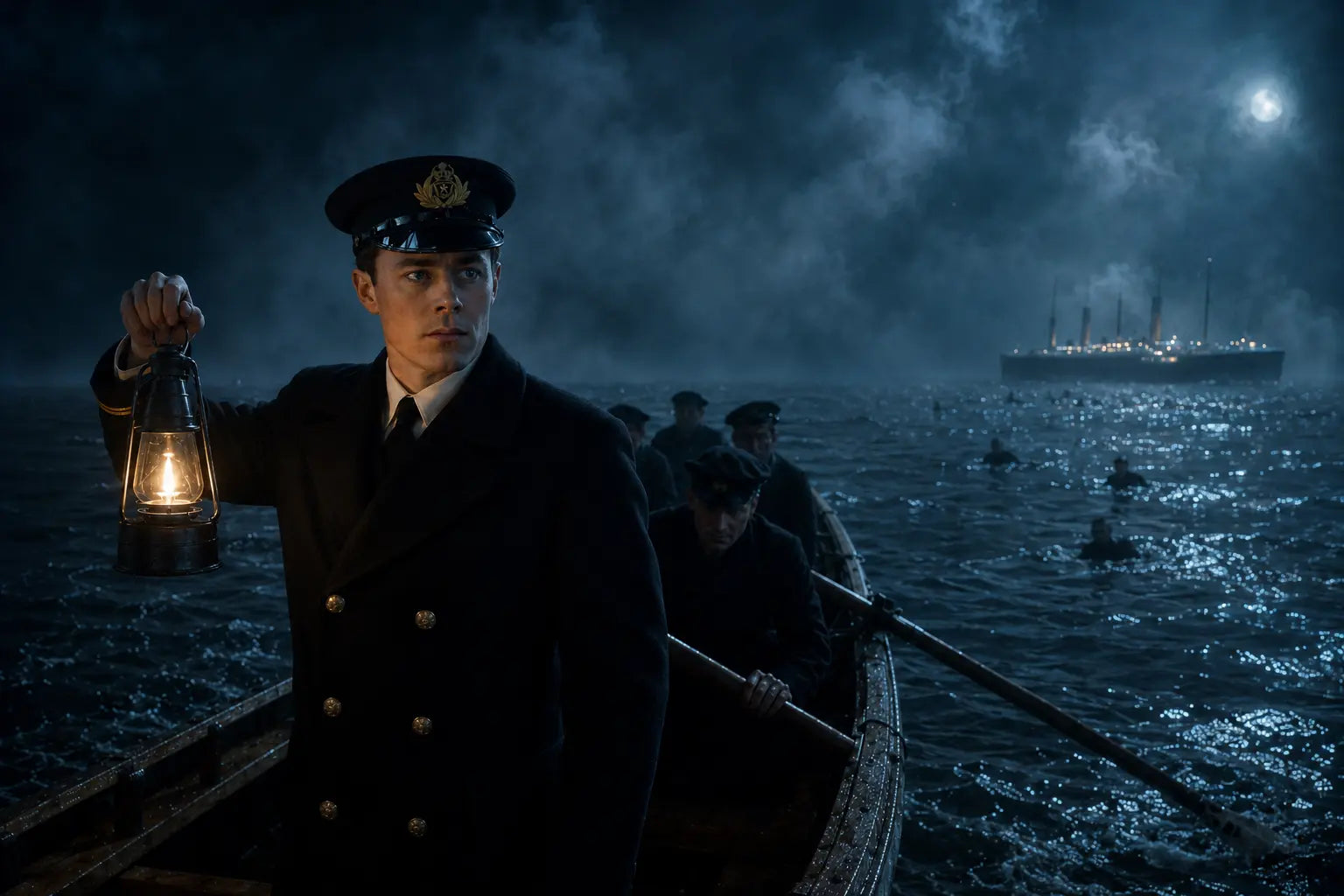
During the night of April 14 to 15, 1912, Ismay eventually entered a collapsible lifeboat, generally identified as Collapsible C. According to his defense, he stepped in when the boat was about to be lowered, after seeing no women or children nearby at that precise moment.
That explanation did not calm public anger. To his defenders, Ismay did not take the place of a woman or child. To his critics, a man in his position should have stayed on board as a matter of honor, even if that meant death.

The scene is difficult to judge from a comfortable distance. The night was freezing, the liner was sinking, passengers were beginning to understand the scale of the disaster, and the lifeboats represented the only chance of survival. In that extreme moment, Ismay chose to live. That choice defined his reputation forever.
⚖️ Was J. Bruce Ismay a Coward or a Scapegoat?
The question was J. Bruce Ismay a coward has followed him for more than a century. It is also one of the hardest questions to answer fairly.
After the sinking, newspapers quickly turned his survival into a moral scandal. Ismay was portrayed as the man who escaped while so many others remained on board or never found a place in a lifeboat. The image was powerful, and it shaped public memory.
Yet the case is more nuanced. Ismay was not the captain. He was not in charge of the evacuation. He was not a deck officer. But he was the chairman of the company that owned the ship, which gave him enormous symbolic responsibility.

That symbolic responsibility explains his fall. He did not only survive a shipwreck. He survived a disaster that seemed to sink the promises of luxury, confidence and modern progress that his company had promoted.
➡️ In the shadow of Titanic’s great destinies, every jewel can become a symbol. The Heart of the Ocean Bracelet brings a delicate touch of blue light to the wrist, inspired by the romance and memory of the legend.
🔎 Why Was Bruce Ismay Blamed for the Titanic Disaster?
Why was Bruce Ismay blamed for the Titanic disaster? Several reasons came together.
First, he survived. In a tragedy where so many men died, where Captain Smith went down with the ship, and where Thomas Andrews became associated with sacrifice and responsibility, Ismay’s survival shocked many people.
Second, he was the chairman of the White Star Line. He represented the company that had launched the Titanic and helped build the public image of an exceptional ocean liner.
Third, there were accusations related to speed. Some accounts suggested that Ismay had spoken about an early arrival in New York. From that came the idea that he might have encouraged the ship to maintain speed despite ice warnings. The issue was examined, but the claim that he gave a direct order to Captain Smith remains disputed.

The result was clear: Ismay’s public image was destroyed. He became one of the most controversial names in the history of the Titanic disaster.
This kind of controversy also shows how cinema and public memory shape the Titanic story. Our article on Titanic’s lasting cultural impact explores why the film continues to influence how people imagine the ship, its passengers and its symbols.
🎬 J. Bruce Ismay in the Titanic Movie
For many viewers, J. Bruce Ismay in the Titanic movie is the version they know best. In James Cameron’s 1997 film, he is played by Jonathan Hyde.
The movie presents him as a man concerned with prestige, publicity and the idea of an impressive arrival in New York. Dramatically, this works very well. It gives the audience a character who seems to embody commercial ambition and overconfidence.
But the movie character should not be confused with the full historical man. Cinema often simplifies people to make a story clearer and more emotionally powerful. In the film, Ismay becomes a symbol of arrogance, social power and misplaced confidence in the Titanic.

In reality, Bruce Ismay was not simply a movie villain. He was a powerful man, certainly, but also a survivor marked by a disaster larger than himself.
🌑 What Happened to J. Bruce Ismay After Titanic?
The question what happened to J. Bruce Ismay after Titanic reveals the lasting force of the scandal.
After the sinking, Ismay was questioned during the official inquiries. He tried to explain his role, his behavior and the circumstances of his survival. But even without being officially condemned as the direct cause of the disaster, he never recovered his former public image.
His reputation was deeply damaged. He resigned from major positions and gradually withdrew from public life. The man who had once represented the ambition of the White Star Line became a quieter figure associated with guilt, shame and judgment.

In a way, Ismay survived physically, but his public life sank with the Titanic. That is why his story remains so haunting.
➡️ Like the memories and promises carried by the Titanic legend, the Heart of the Ocean Ring turns a blue symbol into an intimate jewel, perfect as a romantic keepsake or meaningful gift.
🕊️ Death, Family, Net Worth and Private Life
Bruce Ismay’s life after Titanic still raises many questions. Beyond his survival, readers often want to understand J. Bruce Ismay’s cause of death, his children, his house and his net worth, because these details reveal the man behind the public scandal.
J. Bruce Ismay died on October 17, 1937, in London, at the age of 74. His later years are often described as discreet, far from the public position he held before the Titanic disaster.
On the family side, Ismay was married to Julia Florence Schieffelin. The couple had several children. This private dimension matters because it reminds us that behind the public symbol was also a husband, a father and a man whose family had to live with the shadow of the Titanic.

As for J. Bruce Ismay’s net worth, caution is needed. He clearly belonged to the British economic elite of the shipping world, but giving a modern equivalent would be unreliable without a precise method. His wealth is best understood through his social rank, his role and his connection to the White Star Line.
Regarding J. Bruce Ismay’s house, searches often refer to his residences in England and Ireland, especially his quieter life after the disaster. These places reinforce the image of a man who moved away from the public eye after the sinking.
💬 Religion, Last Words and the God Rumor
Some searches around J. Bruce Ismay religion, J. Bruce Ismay last words, J. Bruce Ismay last photo and the famous claim that even God could not sink the Titanic belong more to popular curiosity than to firmly documented history.
It is important to be careful. No reliable source allows us to attribute with certainty to Bruce Ismay the statement that God himself could not sink the Titanic. That phrase belongs to the wider legends surrounding the ship and has been attached to different people over time.
In the same way, J. Bruce Ismay’s last words are not known as a confirmed historical quotation. His religion is also not a central, well-documented element of his Titanic story.

Answering these questions is useful because people search for them, but it is essential not to turn rumor into fact. Titanic fascinates precisely because it blends documented history, testimony, cinema and legend.
That same border between history and myth appears in the story of the secrets behind the Heart of the Ocean, where fact, symbolism and imagination meet around the famous blue jewel.
🌊 Why J. Bruce Ismay Still Fascinates People
If Joseph Bruce Ismay still fascinates people today, it is because his story asks an uncomfortable question: what would we have done in his place?
It is easy to judge from the present. It is much harder to imagine the freezing night, the ship beginning to tilt, the fear rising on deck, the lifeboats being lowered and the certainty that each minute brought people closer to death.
Ismay became famous not because of the company he led, but because he survived in the wrong place, at the wrong time, with the wrong social status.

His story shows that Titanic is not only a shipwreck. It is a mirror of society: wealth, duty, courage, fear, judgment, reputation and collective memory.
➡️ In this world where elegance meets destiny, the Heart of the Ocean Earrings bring a delicate blue light to the face, like a subtle echo of the jewel that became a legend.
❓ FAQ About J. Bruce Ismay and Titanic
Who was J. Bruce Ismay?
J. Bruce Ismay, whose full name was Joseph Bruce Ismay, was a British businessman and chairman of the White Star Line. He was on board Titanic during its maiden voyage in April 1912.
Did J. Bruce Ismay survive the Titanic?
Yes. Bruce Ismay survived the sinking of the Titanic by entering a collapsible lifeboat. His survival caused major controversy because he represented the company that owned the ship.
How did J. Bruce Ismay survive the Titanic?
He entered Collapsible C as it was being lowered. According to his defense, there were no women or children visible near the boat at that moment.

Was J. Bruce Ismay a coward?
That is the central question linked to his name. Part of the press portrayed him as a coward, but the facts are more complex. He survived, which shocked public opinion, but he was not officially condemned as the direct cause of the disaster.
Why was Bruce Ismay blamed for the Titanic disaster?
He was blamed because he was the highest-ranking White Star Line figure on board, because he survived, and because the public wanted a recognizable face to associate with the catastrophe.
Did Bruce Ismay tell the Titanic to go faster?
This accusation has circulated for decades. Some accounts mentioned conversations about an earlier arrival in New York, but the idea that Ismay gave a direct order to Captain Smith remains disputed.
What happened to J. Bruce Ismay after Titanic?
After the disaster, Ismay was questioned during the inquiries. His reputation was deeply damaged, and he gradually withdrew from public life.
How did J. Bruce Ismay die?
J. Bruce Ismay died in London on October 17, 1937, at the age of 74. His death came after many years of retreat and discretion.

What was J. Bruce Ismay’s cause of death?
Biographical sources state that he died in London in 1937. For the precise medical cause of death, it is better to remain cautious, as public summaries vary in detail.
Did J. Bruce Ismay have children?
Yes. Bruce Ismay was married to Julia Florence Schieffelin, and the couple had several children. His family life is often less discussed than the controversy surrounding Titanic.
What was J. Bruce Ismay’s net worth?
Bruce Ismay belonged to the economic elite of British shipping. His exact net worth in modern terms is difficult to establish, but his social and professional position was very high.
Where was J. Bruce Ismay’s house?
Ismay is associated with several residences in England and Ireland. After Titanic, he became more withdrawn from public life, which adds to the image of a man marked by the disaster.
What was J. Bruce Ismay’s religion?
Reliable public sources do not make his religion a central part of his story. It is safer to avoid unsupported claims on this subject.
Did J. Bruce Ismay say that God could not sink the Titanic?
No reliable source confirms that Bruce Ismay said this. The phrase belongs to the popular legends surrounding Titanic and should not be presented as a verified quote.

What were J. Bruce Ismay’s last words?
There is no widely accepted historical quotation known as Bruce Ismay’s last words. Searches on this topic mainly reflect public curiosity about his fate.
Is there a last photo of J. Bruce Ismay?
Photos of Bruce Ismay exist, especially from his public life and the period surrounding the Titanic inquiries. However, the idea of a clearly identified final official photo should be treated with caution.
Who played J. Bruce Ismay in the Titanic movie?
In James Cameron’s Titanic, J. Bruce Ismay was played by actor Jonathan Hyde. The film strongly influenced the modern image of Ismay as an ambitious and controversial figure.
✨ Conclusion
J. Bruce Ismay will probably remain one of the most debated survivors of the Titanic. He was not the captain, not the ship’s architect and not the officer in charge of navigation. Yet his name still carries the weight of the disaster.
Was he a coward? Was he guilty? Or was he a man who survived an impossible night and then lived under the burden of public judgment? The answer depends on how we read history. The facts invite more nuance than the legend.
Ismay represents an essential part of the Titanic myth: the judgment placed on survivors, the difficulty of separating moral responsibility from direct responsibility, and the power of press and cinema to shape collective memory.
More than a century after the sinking, his story reminds us that Titanic fascinates not only because of its luxury or its loss. It fascinates because it reveals human contradictions: fear, duty, prestige, shame, survival and memory.
Within that memory, the blue jewel holds a special place. It reminds us that Titanic is not only a name in the archives, but a world of emotion, destiny and legend that continues to inspire.
If you are drawn to jewelry as a keepsake of love, memory and emotion, our article on jewelry as a symbolic gift explores why certain pieces become so much more than accessories.

*The visuals featured in this article are original illustrations created by our editorial team with the assistance of artificial intelligence tools. They do not depict the actual people mentioned and do not reproduce any copyrighted material.