
Table of Contents
🧭 Who Was Joseph Bell on the Titanic?
Joseph Bell is one of those names long overshadowed by the grandeur and tragedy of the Titanic, despite playing a role that was absolutely essential to the ship’s operation and to the survival of hundreds of passengers. Little known to the general public, he was in fact the chief engineer of the Titanic, responsible for the ship’s technical heart, the place where everything functioned, or ultimately failed.
Born in Scotland in the nineteenth century, Joseph Bell was a highly experienced marine engineer, widely respected for his discipline, professional rigor, and calm under pressure. By the time he boarded the Titanic in April 1912, he was not embarking on a routine assignment, but reaching the culmination of a career devoted entirely to steam-powered maritime engineering.
Unlike the wealthy passengers strolling along the grand decks, Joseph Bell’s world was hidden deep below. His domain was the engine rooms, an intense environment filled with heat, noise, and constant motion. Under his authority worked dozens of engineers, mechanics, and firemen, all tasked with maintaining the boilers, generators, electrical systems, and pumps that kept the ship alive.

At a time when electricity aboard an ocean liner was still a major technological innovation, Joseph Bell occupied a position of critical importance. Without his team, there would have been no lighting, no internal communications, no functioning pumps, and no power for essential systems. In other words, without engineering, the Titanic was nothing more than an empty hull.
Today, countless online searches still begin with a simple question: “Who was Joseph Bell on the Titanic?” The answer goes far beyond a biographical summary. Joseph Bell represents a form of quiet heroism, embodied by men who were never meant to be seen, yet whose actions proved decisive in one of the most famous maritime disasters in history.
➡️ Behind the Titanic legend lies a gemstone surrounded by mystery. Discover the true story of the Hope Diamond, its history, value, and real owner.
⚙️ Joseph Bell, Chief Engineer of the Titanic
On the Titanic, the title of Chief Engineer was not ceremonial. Joseph Bell directed the ship’s entire technical operation: propulsion, steam management, electrical generation, power distribution, ventilation, pumps, and a large share of the systems that kept the liner stable and functional. In practical terms, he was responsible for everything that allowed the Titanic to move, to operate efficiently, and to remain safe in the middle of the Atlantic.
To understand the scale of this responsibility, it helps to picture the Titanic as a floating industrial city. Beneath the luxury and the spectacle, there was a strict hierarchy of skilled professionals. Joseph Bell supervised a chain of command that included senior engineers, assistant engineers, and multiple specialized roles. Under them, mechanics, greasers, firemen, and stokers worked in relentless shifts to feed the boilers, regulate steam pressure, monitor turbines, and keep the generators running.
The Titanic was a technological giant for its era. Its power relied on a precisely coordinated routine: from the boiler rooms to the engine rooms, every task was timed, every inspection repeated, every unusual sound investigated. In that environment, Joseph Bell served as both conductor and safeguard. He had to anticipate failures, enforce discipline, and make quick decisions, even when fatigue and heat reduced every movement to effort.

One question appears again and again online: what did the Titanic’s chief engineer actually do? The answer is more than supervision. Joseph Bell was expected to ensure procedures were respected, maintenance standards were met, and the engineering crew remained ready for any emergency, from mechanical breakdowns to a sudden breach and flooding. The role also carried a moral dimension: protect the ship and the lives on board by keeping critical systems stable for as long as possible.
That is why modern readers often look beyond job titles and search for the man himself, through queries such as “Joseph Bell Titanic engineer” or “Joseph Bell Titanic Wikipedia”. They are not only trying to identify a function. They want to understand a mindset: the discipline of a professional trained to keep order where chaos can erupt in seconds.
And this is where Joseph Bell’s story becomes truly unforgettable. Because when the Titanic’s fate changed in a single collision, it was in the depths of the ship, among steam, metal, and roaring machinery, that his decisions mattered most.
➡️ If the Titanic fascinates you through its symbols as much as its history, explore the legend behind the jewel that captivated the world: the Heart of the Ocean Necklace.
🌊 Joseph Bell During the Titanic Sinking
On the night of April 14 to April 15, 1912, when the Titanic struck the iceberg, Joseph Bell was exactly where his duty placed him: deep inside the ship, far below the passenger decks. While the collision was barely perceptible in the lounges and cabins, its consequences were immediately understood in the engine and boiler rooms. Unusual vibrations, pressure changes, and the first signs of flooding alerted the engineering crew that something was seriously wrong.
At that precise moment, the role of the Titanic’s chief engineer became critical. As evacuation preparations slowly began above, Joseph Bell coordinated his men around a single, dangerous objective: keep the ship powered for as long as possible. Without electricity, the Titanic would be plunged into total darkness, making any organized evacuation nearly impossible.

Under his direction, engineers continued to feed the boilers, manage steam flow, and operate the generators, even as seawater began entering the lower compartments. Every minute of power meant illuminated corridors, functioning communication systems, and working pumps. Each of those minutes translated into lives saved on the decks above.
Many people still search today for answers to one haunting question: what was Joseph Bell doing during the Titanic sinking? The historical record is clear and deeply moving. He did his job until the end. There was no formal order forcing him to stay. It was a conscious decision, driven by professional responsibility and an unwavering sense of duty toward the passengers and his crew.
As the situation deteriorated, conditions in the engine rooms became almost unbearable. Cold water advanced steadily, steam filled the air, and physical exhaustion set in. Yet Joseph Bell and his team did not abandon their posts. They knew the risks. They knew their chances of survival were minimal. Still, they continued.
This is why Joseph Bell’s actions during the sinking stand apart. There was no dramatic gesture, no audience, no expectation of recognition. His courage was silent and technical, hidden beneath steel decks and roaring machinery, but it played a decisive role in one of the most tragic nights in maritime history.
➡️ The courage of Joseph Bell raises deeper questions about our fascination with the Titanic. And one mystery still captures imaginations around the world: did the Heart of the Ocean really exist?

🕯️ The Sacrifice of Joseph Bell and His Team
As the situation aboard the Titanic became irreversible, Joseph Bell understood that every remaining minute mattered. Deep below the waterline, freezing seawater advanced steadily while the heat of the boilers and the roar of the machinery created extreme working conditions. Yet even as escape routes disappeared, the Titanic’s chief engineer never ordered his men to abandon the engine rooms.
Alongside Joseph Bell, more than thirty engineers, mechanics, and firemen continued their work. Their mission was clear and uncompromising: maintain electrical power for as long as possible. As long as the lights stayed on, evacuation could continue in relative order. Corridors remained visible, signals functioned, and lifeboats could be launched without plunging the ship into chaos.
This decision, often summarized today by searches such as “Joseph Bell Titanic sacrifice”, was neither accidental nor imposed by protocol. It was a professional choice taken with full awareness of its consequences. By remaining at their posts, Joseph Bell and his team knowingly gave up their own chances of survival, buying precious time for hundreds of others.

Unlike the dramatic scenes unfolding on the upper decks, the engineers’ sacrifice occurred far from public view. There were no witnesses, no applause, no final words recorded. And yet, survivor accounts later confirmed a crucial detail: the ship’s lights remained on almost until the very end. This was the unmistakable sign that the Titanic’s technical heart continued to beat as the ship sank.
In maritime history, few acts illustrate the idea of absolute duty as powerfully as this one. The sacrifice of Joseph Bell on the Titanic was not defined by a single heroic gesture, but by sustained discipline, loyalty to a mission, and professional integrity maintained even when hope was gone.
Today, this choice commands deep respect. It reminds us that the Titanic disaster was not only a story of loss, but also a series of quiet acts of courage carried out by men who accepted their fate so that others might live. Among them, the name Joseph Bell stands as a lasting symbol of responsibility and selflessness.
➡️ Inspired by the legend of the Titanic, the Heart of the Ocean Earrings echo that legacy through a creation shaped by emotion and timeless elegance.
🎬 Joseph Bell in the 1997 Titanic Movie
The 1997 film Titanic introduced millions of viewers to the story of the legendary ocean liner and its tragic fate. For many, it became the starting point of a deeper interest in the real people behind the disaster. One question appears frequently in online searches: does Joseph Bell appear in the 1997 Titanic movie?
The answer is nuanced. Joseph Bell is not named explicitly in the film, and no character is officially identified as him. However, his role and his actions are clearly represented through several powerful scenes showing engineers and mechanics remaining at their posts in the engine rooms as the ship begins to sink.
These moments, brief yet unforgettable, closely reflect the historical record. The film depicts men continuing to operate generators, monitor gauges, and manage steam pressure even as water floods the lower decks. This portrayal aligns with what is known about Joseph Bell, the Titanic’s chief engineer, and the men under his command.

Many viewers search for terms such as “Joseph Bell Titanic movie” or “Joseph Bell Titanic 1997”, hoping to connect a specific face to the name. The filmmakers made a deliberate choice not to individualize this character. Instead, the engineering crew is presented as a collective figure of duty and sacrifice, allowing Joseph Bell’s presence to be felt through their actions rather than through dialogue.
This artistic decision strengthens the message. Joseph Bell’s courage was never about personal recognition. It was about teamwork, discipline, and commitment to a responsibility larger than oneself. By honoring the engineers as a group, the film captures the true spirit of his sacrifice.
In this way, Joseph Bell is very much present in the 1997 film, even without a name on screen. He is there in every light that remains on, in every generator that keeps running, and in every moment of time gained for those struggling to escape above.
➡️ One of the most unforgettable characters of the film remains Rose. Discover the truth behind her story in Rose DeWitt Bukater: history, age and truth.
✉️ Did Joseph Bell Write a Letter Before the Titanic?
Among the many questions surrounding Joseph Bell, one appears with striking regularity in online searches: did Joseph Bell write a letter before boarding the Titanic? This curiosity reveals a desire to look beyond the engineer’s professional role and glimpse the man himself, his thoughts, and what he may have left behind before departure.
Unlike some passengers whose final messages became widely known, no personal letter written by Joseph Bell before the Titanic’s voyage has been officially preserved or authenticated. There is no dramatic farewell note, no premonition-filled message comparable to those sometimes highlighted in popular retellings of the disaster. This absence has fueled speculation, particularly around searches such as “Joseph Bell Titanic letter”.
However, the lack of a famous letter does not mean the absence of personal correspondence. Like many marine engineers of the early twentieth century, Joseph Bell regularly wrote to his family during his assignments at sea. These letters, private by nature and rarely published, were typically practical and restrained, focused on daily routines, work conditions, and reassurance rather than emotion or foreboding.

What stands out in hindsight is precisely this sense of normalcy. Joseph Bell boarded the Titanic simply to do his job, without ceremony or expectation of danger. Although the ship’s maiden voyage carried prestige, it was not perceived at the time as an extraordinary risk by experienced professionals like him.
Modern discussions, sometimes amplified on forums and community platforms, attempt to fill this silence with imagination. Yet the historical reality may be more powerful. The absence of a dramatic final letter underscores a simple truth: Joseph Bell is remembered not for what he wrote, but for what he did when the moment of decision arrived.
His legacy rests on action rather than words. And those actions, carried out quietly below deck, continue to define Joseph Bell’s place in Titanic history far more strongly than any written message ever could.
➡️ Inspired by the Titanic’s enduring symbolism, the Heart of the Ocean Bracelet reflects memory, emotion, and timeless elegance.
👨👩👦 Joseph Bell, His Family and His Son
Beyond his role as the Titanic’s chief engineer, Joseph Bell was also a husband and a father. Many modern searches reflect this human curiosity, with questions such as “Joseph Bell Titanic family” or “Joseph Bell Titanic son” appearing frequently. These queries reveal a desire to understand not only what he did, but what he left behind.
Joseph Bell was married and had children. Like many marine engineers in the early twentieth century, his professional life required long periods at sea, balanced by quieter moments at home with his family. His work provided stability and respect, but it also meant prolonged absences, a common reality for families connected to maritime service at the time.
Information about Joseph Bell’s son and his descendants remains limited. There is no widely documented or publicly detailed family tree, unlike those of certain high-profile passengers. This discretion aligns with Bell’s own life, which unfolded largely away from public attention. He was a professional whose identity was defined by responsibility rather than notoriety.

After the Titanic disaster, Joseph Bell’s family joined the many others who mourned loved ones lost at sea. For the relatives of engineers and mechanics, the grief was often private and understated. Their sacrifice, though decisive, did not immediately receive the same recognition as that of officers or first-class passengers.
For his loved ones, Joseph Bell was not a symbol or a historical figure. He was a father, a husband, and a man committed to his profession. His sudden absence left a lasting void, shaped by both pride and loss. This personal dimension adds profound weight to his story, reminding us that behind every name listed among the Titanic’s victims was an entire life of relationships and responsibilities.
Understanding Joseph Bell through his family deepens the meaning of his final choice. It highlights the personal cost of his decision and reinforces why his legacy continues to resonate more than a century later.
➡️ One of the most enduring figures of the Titanic story remains Jack. Discover the truth behind his character in Jack Dawson: real story, age, death and secrets.
📚 Joseph Bell on Wikipedia and in Official History
Many readers first encounter Joseph Bell through searches such as “Joseph Bell Titanic Wikipedia”. This reflects a broader shift in how the Titanic story is explored today: beyond the ship itself and its famous passengers, there is a growing interest in the technical crew whose actions proved decisive during the disaster.
On Wikipedia and in official historical records, Joseph Bell is identified as the Chief Engineer of the Titanic, lost during the sinking on April 15, 1912. The information available is generally concise and factual, outlining his role, his responsibility over the engine department, and the acknowledgment that he remained at his post until the end.
This relative brevity is not unusual. Unlike captains, senior officers on deck, or wealthy first-class passengers, engineers and mechanics rarely left extensive public documentation. Their stories are reconstructed primarily from company records, technical logs, survivor testimonies, and later historical analyses.

Over time, however, Joseph Bell’s place in Titanic history has grown in significance. Maritime historians and researchers now emphasize that the engineers’ decision to maintain power and lighting directly influenced survival rates. Without electricity, communication would have failed earlier, corridors would have plunged into darkness, and the evacuation would have descended into chaos far sooner.
As a result, Joseph Bell is increasingly recognized as one of the key technical heroes of the Titanic. Even if his Wikipedia entry remains modest in length, the meaning behind his actions has expanded through documentaries, books, and in-depth historical websites dedicated to the engineering side of the disaster.
This evolution shows how history is not static. What was once summarized in a few lines is now understood as a crucial chapter of the Titanic narrative. Joseph Bell’s legacy, grounded in professionalism and duty rather than fame, continues to gain the recognition it long deserved.
➡️ A refined echo of the Titanic’s legend, the Heart of the Ocean Bracelet embodies elegance, symbolism, and quiet emotion.
🛠️ The Forgotten Heroes of the Titanic
The story of the Titanic is often told through the lens of luxury, tragedy, and iconic figures. Yet some of the most decisive actions taken during the disaster occurred far from the grand staircases and upper decks. Deep below, in the heat and noise of the engine rooms, worked the engineers and mechanics of the Titanic, men whose names remained largely absent from popular memory for decades.
Joseph Bell stands as the most prominent representative of these forgotten heroes, but he was supported by an entire technical workforce. Firemen, trimmers, greasers, oilers, and junior engineers formed a tightly organized system responsible for keeping the ship alive. Their daily work was physically exhausting, demanding constant vigilance and discipline.
When the Titanic struck the iceberg, these men immediately understood the danger of their position. As water began to enter the lower compartments, their chances of escape diminished rapidly. Despite this, they did not abandon their posts. Under Joseph Bell’s supervision, they continued to operate boilers, manage steam pressure, and sustain electrical power for as long as possible.

This collective decision is why historians now refer to them as the forgotten heroes of the Titanic. Their actions were not dramatic in appearance, but they were critically effective. Every additional minute of light, heat, and power meant safer access to lifeboats and reduced panic among passengers.
For many years, their contribution was overshadowed by more visible acts of leadership on deck. Only later did researchers begin to fully appreciate the scale of their sacrifice. Technical analyses and survivor testimonies confirmed that the engineers’ efforts directly influenced the number of lives saved.
Today, the memory of these men is gradually being restored. Articles, documentaries, and historical studies increasingly emphasize that the Titanic’s final hours were shaped not only by command decisions on the bridge, but also by unwavering professionalism below deck. Joseph Bell and his team embody a form of heroism rooted in duty, teamwork, and quiet resolve.
Recognizing these forgotten heroes offers a more complete understanding of the disaster. It reminds us that history is often shaped by those who work without applause, whose courage is measured not in visibility, but in responsibility carried to the very end.
➡️ More than a century later, fascination with the Titanic remains strong. One question continues to spark curiosity worldwide: will Titanic 2 ever be released?
✨ Why Joseph Bell Still Fascinates Today
More than a century after the sinking of the Titanic, Joseph Bell continues to attract attention, research, and admiration. This lasting fascination goes far beyond maritime history. It touches something deeply human: the question of how an ordinary professional behaves when confronted with an extraordinary situation.
Joseph Bell fascinates because he represents a form of heroism without spectacle. He was not a wealthy passenger, not a charismatic officer on deck, and not a figure seeking recognition. His actions unfolded far below the surface, in an environment defined by noise, heat, and danger. And yet, those actions had a decisive impact on the outcome of the disaster.
In a modern world often driven by visibility and personal recognition, Bell’s story feels strikingly different. He did not act to be remembered. He acted because it was his responsibility. This sense of duty, carried out with discipline and calm, resonates strongly with contemporary readers who see in him a counterpoint to more dramatic or self-centered forms of heroism.

Another reason Joseph Bell remains compelling lies in his relatability. He was not a mythic figure or a larger-than-life character. He was a skilled engineer, a husband, a father, and a team leader. Many people can imagine themselves in his place, facing a moral choice between self-preservation and responsibility toward others. That proximity makes his decision all the more powerful.
Discussions about Joseph Bell often extend beyond the Titanic itself. They raise broader reflections about professional ethics, leadership under pressure, and collective responsibility. In this sense, Bell’s legacy is not confined to 1912. It continues to speak to modern professions where lives depend on competence, teamwork, and the willingness to act when no one is watching.
Ultimately, Joseph Bell fascinates because his story does not rely on legend or embellishment. It is grounded in documented actions, quiet determination, and a final choice that speaks for itself. His name endures not because it was meant to, but because it deserves to.
➡️ Curious about the man who kept baking as the Titanic went down? Discover the incredible true story of Charles Joughin, the Titanic’s Chief Baker.
❓ FAQ - Joseph Bell and the Titanic
Who was Joseph Bell on the Titanic?
Joseph Bell was the Chief Engineer of the Titanic. He was responsible for the entire engine department, including boilers, engines, generators, and electrical systems. During the sinking, he remained at his post with his team until the very end.
What did Joseph Bell do during the Titanic sinking?
During the sinking, Joseph Bell coordinated his engineers to keep electricity and power running for as long as possible. This ensured lighting, communication, and safer lifeboat operations, helping many passengers escape in better conditions.

Did Joseph Bell survive the Titanic?
No. Joseph Bell did not survive the Titanic disaster. Like the engineers under his command, he stayed in the engine rooms and perished when the ship sank.
Is Joseph Bell shown in the 1997 movie Titanic?
In the 1997 film Titanic, Joseph Bell is not named or portrayed as an individual character. However, his role is clearly represented through scenes showing engineers continuing to work in the engine rooms as water rises.
Did Joseph Bell write a letter before the Titanic voyage?
There is no publicly known or authenticated letter written by Joseph Bell before the Titanic’s departure. Any personal correspondence he may have written to his family has not been preserved or released to the public.
Did Joseph Bell have a family and a son?
Yes. Joseph Bell was married and had children. Information about his son and descendants remains limited, reflecting the private nature of his family life and the historical focus on passengers rather than technical crew.
Why is Joseph Bell considered a hero of the Titanic?
Joseph Bell is considered a hero because he chose duty over survival. By keeping power and lighting operational, he helped reduce panic and improve evacuation conditions, directly contributing to lives being saved.

What does Wikipedia say about Joseph Bell?
On Wikipedia, Joseph Bell is listed as the Chief Engineer of the Titanic, who died during the sinking. While the entry is concise, historians increasingly emphasize the importance of his actions during the disaster.
Why do people still search for Joseph Bell today?
Joseph Bell continues to fascinate because he represents silent courage, professional ethics, and responsibility. His story offers a deeply human perspective on the Titanic tragedy, beyond luxury, spectacle, or fiction.
📌 Conclusion - Joseph Bell, a Lesson in Silent Courage
The story of Joseph Bell reminds us that the tragedy of the Titanic cannot be reduced to a shipwreck or a symbol of technological hubris. It was also a moment defined by human choices, made far from the spotlight, in environments where fear, heat, noise, and danger left little room for hesitation.

By remaining at his post until the very end, Joseph Bell, Chief Engineer of the Titanic, did not seek recognition or glory. He simply fulfilled his duty with discipline, calm, and unwavering responsibility. It is precisely this lack of spectacle that gives his actions such enduring power.
Through his story, we rediscover an entire group too often overlooked: the engineers, mechanics, firemen, and trimmers whose work kept the Titanic functioning during its final hours. Their contribution was invisible to most passengers, yet absolutely vital. Without them, the evacuation would have been darker, more chaotic, and far deadlier.
More than a century later, Joseph Bell’s legacy stands as a timeless reminder that true courage does not always announce itself. It is sometimes found in consistency, professionalism, and the decision to stay when leaving would be easier.
In remembering Joseph Bell, we honor not only a man, but a principle: that responsibility carried through to the end can change the course of history, even when no one is watching.

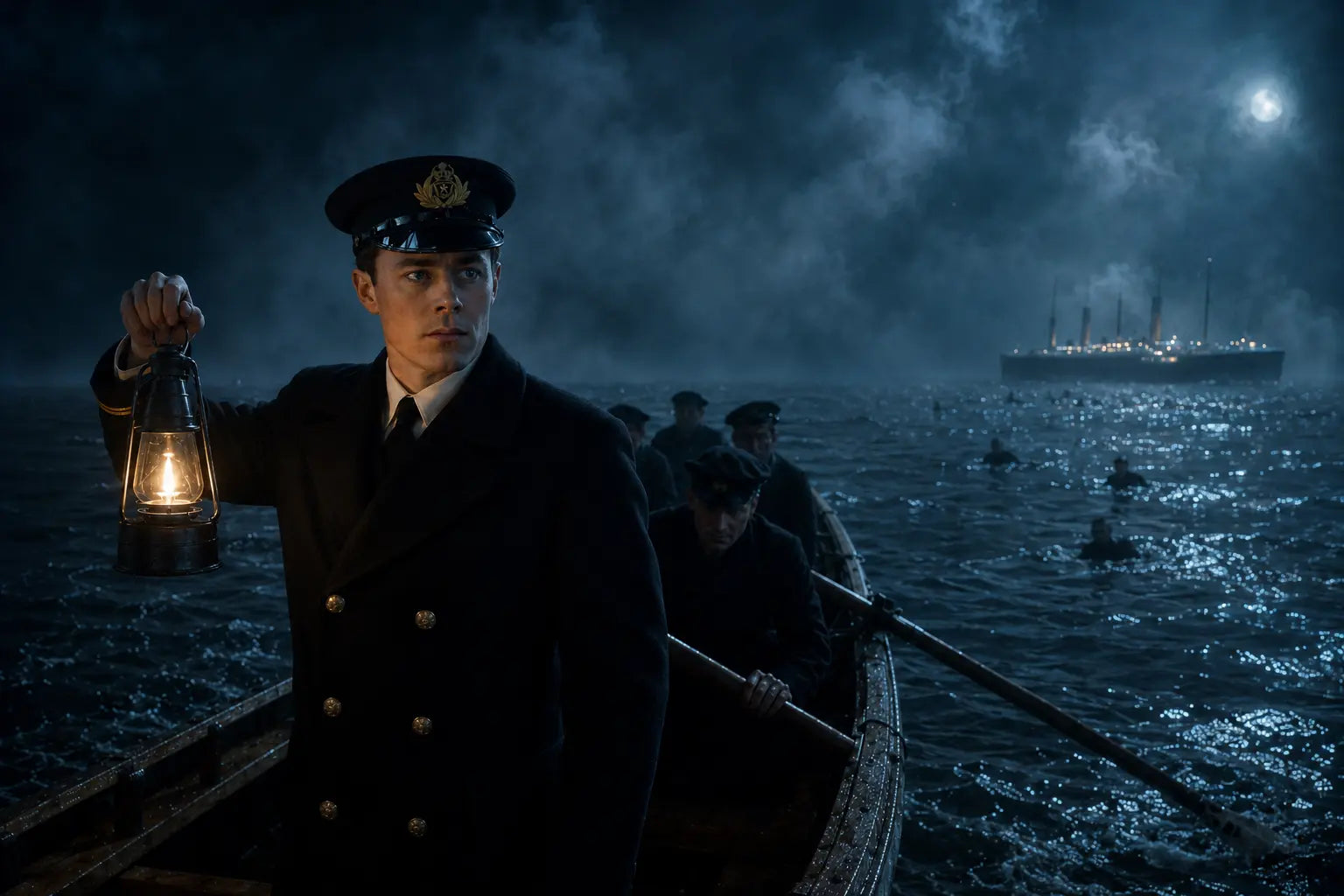
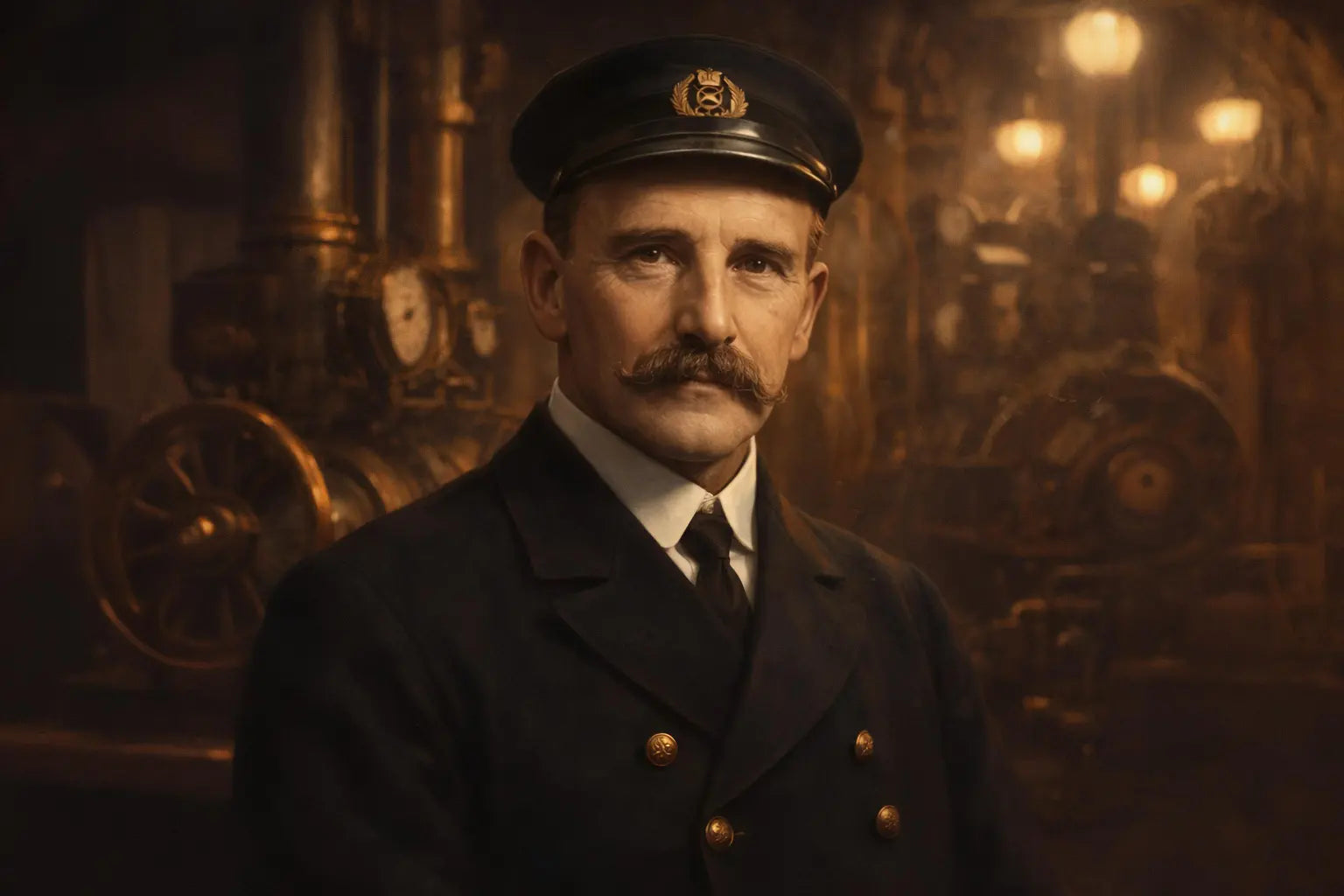
*The visuals featured in this article are original illustrations created by our editorial team with the assistance of artificial intelligence tools. They do not depict the actual people mentioned and do not reproduce any copyrighted material.